Thursday, March 28, 2013

Harry Potter Readalong, Order of the Phoenix II: "Does this mean they're going to shut down the Gobstones Club?"

RIGHT. So. Halfway through.

Umbridge is a lovely vessel for cathartic anger.

Hermione saying "V-Voldemort" is seriously cute, only wtf because she didn't grow up being afraid of his name, so her reaction should be like Harry's and what's going onnnnnnn, book.

I'm really, very much not looking forward to Grawp.

Also:

The Hog's Head bar comprised one small, dingy, and very dirty room that smelled strongly of something that might have been goats.


I guess I'll just address the main reason I dislike Sirius, as it's pretty much what fucks things later on. Let's look at the end of the chapter "Percy and Padfoot." Sirius appears in the fire. Very nice. Sirius yet again offers, like an idiot, but a cooped-up, been-in-Azkaban-and-now-is-trapped-in-a-hated-house idiot (so it's understandable), to "disguise" himself and see Harry in Hogsmeade.


Harry, finally NOT acting an idiot, says no. Rather than just look disappointed, or perhaps stew on his own, the following assholery happens:

"You're less like your father than I thought," he said finally, a definite coolness in his voice. "The risk would've been what made it fun for James."


OMG Sirius you're SUCH. an ASSHOLE. This is primarily why I get touchy about him and am utterly confused as to why people love him. Because no. Nope. Sure, Harry's pretty terrible in this book. Especially when he won't stop saying lame things to Umbridge that keep getting him detention. But what Sirius says, in this fit of complete dickdom, is:

1) Extremely painful because Harry never knew his parents, and people likening him to his dad is one of his sure sources of joy in the first five years 

2) Said to someone who essentially only has him and who has until now (post-PoA) solely seen him in the light of a friend, guardian and protector

3) Completely disregarding the danger not only to Sirius, but to Harry, who if caught with a known mass murderer in the guise of an unregistered Animagus, could easily be sent to Azkaban. It's not like Sirius is unaware of the Ministry's feelings towards Harry.

4) As mentioned, this has dire consequences at the end. I would argue Harry's actions there are at the very least in part because of this earlier statement.

Basically Sirius is the worst.


Readathons and Book Expos

BOOKISH EVENT THINGS.


Ok, so as Kayleigh V has reminded us, Dewey's 24 Hour Readathon is a month away, which is CRAZY and also I've never actually done it because things always come up but THIS IS MY YEAR so it'll happen and also BEA so really all the bookish things. But yes, so go sign up and then later we'll discuss what we're going to read and HURRAH. I still very much want to get a hotel room and do a hole-up thing -- mostly because I am 90% sure I won't get much reading done in my apartment, as it has All the Distracty Things -- but it costs moniiiies and also what if I get pulled away by the prospect of a tv with channels.


I know we've discussed BEA before, but it is looking more and more likely that I'm going. So. People should hotel it with me. Because then it'll be like a slumber party except for the part where I fall asleep at 11 pm because, let's face it, I am no longer one of those chickens of the spring.


AND THEN we will take the ferry and look at the Statue of Liberty, AND THEN we will go to various historical landmarks that I have not yet seen, AND THEN we will see Nice Work If You Can Get It, starring Miss Jessie Mueller who played Helena Landless in Edwin Drood, AND THEN....eat things? Yes, eat things. I am the Queen of Itineraries. Tell me what you wish to do, and I will figure out how we will get there and how much it will cost.

So basically I'm super-excited about both of these things. Also about the Supreme Court justices. But let's ignore that for now.

Wednesday, March 27, 2013

"I am just going to be polite and silly, and point at cool things," I decided.


I want to write about Moranthology. I'm slightly worried about doing it justice, as I was up late last night attending my former professors' discussion about their new book, which has an awesome cover and is about Mad Men. I don't watch Mad Men because why would I want to watch sexism if I don't have to, but TO EACH HIS OWN. Also, again. Nice cover.

SO. Caitlin Moran. My journey to you has been tortuous -- NOT torturous -- and filled with lengthy detours consisting of other minor British personalities and now I am here and I like you but am also a bit wary, as one generally is with people who express their opinions rather extremely strongly. (UNLESS THEY INCLUDE GIFS RIGHT?)


Despite the awesome Laura from Devouring Texts sending me Moran's How to Be a Woman A YEAR AGO, I instead have ended up reading her essay collection, because it was from the library and an eBook. These are the life choices I have made. BUT I do quite like essay collections. One might even say they are my favorite. Because they leave you with such a sense of accomplishment and, for the dumber among us, they provide very handy resting points.

"Oh, this essay's done? And it was only three pages? BRAVA ME, I deserve to watch some Surreal Life on Hulu."

The book mostly consists of columns she's written for various publications, and since they're columns they're pretty much all delightfully short. I take forever to finish books (as some may know) and I think I read this in like two days. I do like her a lot. In a 'I will read more things you write and probably agree with most of them and laugh quite a bit' way. Which, if you think about it, is a pretty good way.

Quotes? Why, sure.

On why comedic writing is so much more important than serious writing:
[H]ow many penetrating insights into human nature do you need in one lifetime? Two? Three? Once you've realized that no one else has a clue what they're doing, either, and that love can be totally pointless, any further insights into human nature just starts getting depressing, really.

On Downton Abbey (er, spoiler for season one, but if you haven't watched it yet, let's be honest, you're not gonna watch it):
This is, after all, the drama where an evil, chain-smoking maid caused her mistress to miscarry by deliberately leaving lilac-scented soap on the floor, which she slipped on. Yeah, that's right. She killed the unborn Earl of Downton with soap. This is a plot twist not even Dynasty, at its most gibbering, considered. 
He even gets around to telling Anna his plans for their future life:'I want to open a little hotel, in the countryside,' he says, holding her hand outside the scullery.The Bates Hotel? Really? That's honestly his plan?
And on traveling:

Every time I think of some distant wonder I might quite like to see--Sydney Harbour at night, for instance; or Venice from a bridge--I ask myself, 'Do I want to see it so much that I would take my shoes off at Heathrow security at 6:55 AM?'  
And every time the answer comes back, 'No. I would rather keep my shoes on and watch a documentary about them instead, thank you.' 

Really it's all quite awesome. She even gets in some serious bits about feminism and Amy Winehouse (not...in the same essay). 


Plus there's the greatest essay about libraries, which I believe Laura touched on in her review back in the day. She talks about how growing up in a little nothing of a town was ameliorated by the presence of the library. Which reminded me of my hometown's library, which used to be the most hideous 1970s aluminum thing (they have since demolished it and built a beautiful one), but I loved it SO much because it had microfilm machines and biographies of Debbie Reynolds and opera recordings that came in old plastic bags because they had to include the libretto. It was the only thing of any note I was permitted to walk to from my house. It was the first place I went when I got my driver's license.

Anyone who writes a gorgeous essay in support of libraries earns a fivefold increase in my estimation of them.

So read this. It's funny. It's insightful. It's quick. And then we'll all read How to Be a Woman and DISCUSS. Because I want to know if I can finally rid myself of my guilt over loving the song I Enjoy Being a Girl as ridiculously much as I do.

Tuesday, March 26, 2013

We're past the Ides of March. Thank God, right?

I have high hopes for my March as regards reading. Mainly because we're almost at the end of it and I seem to have read a lot of shit. I can't start out the month with high hopes, because then if I read nothing I shall be terrifically disappointed in myself. But as it stands on the 26th, I AM ROOTING FOR YOU, ME.


Yesterday I finished Anna and the French Kiss and immediately tried out one, two, three different library eBooks. I was like the Goldilocks of Overdrive. (if you do not know what Overdrive is, your life is unfulfilled)


The first was Isabel Wilkerson's The Warmth of Other Suns. Oh, how this book has been lauded. Oh, how intelligent Wilkerson seemed when she guested on NPR. And -- oh, it's partially done in a fictional narrative style. Nope.


Next up was The Uninvited Guests by Sadie Jones. It is entirely possible that this book gets fantastic after the first chapter. But to be honest, despite my love of Victorian novels and warm fondness for Wodehouse, I'm not that into early to mid 20th century English novels set in the country. This is partially how I avoided Downton mania. "Oh, Reginald, do make sure Simpkins has brought in the tennis things before the Vandemeres arrive; I hate to think about the lawn looking like a junkyard. When will Winifred and her friends learn?"


Not for me.


And of course, the littlest bear was: Confessions of a Shopaholic. Which seems to be a Bridget Jones knockoff and I am FINE with that.


With a [Financial Times] under your arm, you can talk about the most frivolous things in the world, and instead of thinking you’re an airhead, people think you’re a heavyweight intellectual who has broader interests, too.
This is how I use opera. "Oh, you were going to judge my love of Britney Spears's first album? OR I COULD SING IN ONE OF EIGHT LANGUAGES FOR YOU. Very good, back to 'E-Mail My Heart' and how it is under-appreciated by the public at large."

So I'm very much enjoying that book. I'm also working on: Lamb, Passions Between Women, OotP (obvs), Oscar Wilde's Last Stand, Barnaby Rudge, Sharp Objects, and other random things, mostly Dickensian in nature. You know why? Because STARTING books is the funnest. But the middle parts, not so exciting. Books that make me want to keep returning to them instead of spreading my attention among their compatriots are extremely rare and usually involve a mix of humor and the desire to see two people make out.

So, Attachments and Anna and the French Kiss, you're both doin' real well.

Thursday, March 21, 2013

Harry Potter Readalong, Order of the Phoenix I: "Don't think about that," Harry told himself.

This book makes me emotional. This is perhaps an understatement. Because this book makes everyone emotional. If I could marry this book — not in a weird, I'm sexually attracted to inanimate objects way, but in a "this is how much I would like to prove my eternal devotion to you" way — I would. So, People Having a Beef With It, while I perfectly understand that everyone has their opinion, I'm going to act like a total 5-year-old regarding criticism of it and just be aware of that.

be aware.

I don't know how...I glanced through the previous four. But with Order of the Phoenix, I started on page fucking one and then threw myself into the experience with sheer delight. I love everything about this. Except maybe Grawp. But we'll get to him later. If we could do a post on each chapter, I would be thrilled. But in the interests of Harry Potter Readalong harmony, we're gonna do four and not 38.


Things people aren't going to like: Harry bitches all the time.


But you know fucking what? LOOK AT THE POST TITLE. Because that is a THING. THAT HAPPENS. He SAYS that to himself. Wtf Hogwarts. WTF. He watched a kid die, WHICH HE BLAMES HIMSELF FOR, then he almost died, and you just let him try to sort that out for himself at age 15 during his summer break. WHAT IS WRONG WITH YOU.

So yeah. If Harry's acting a little emotional or kind of like an irritating teenager, HOLY SHIT he has 5 billion percent more reason than most.

I think this book is when I started connecting with things a whole lot more than I did in the previous ones, which is probably why I feel so strongly about it. Everything in it gets so much more complex and rich and — obviously — dark. We see the Order of the Phoenix's headquarters, which is important for the rest of the series. We meet Luna. We see thestrals, even if most people can't (btdubs, have most people seen someone die? because I saw my grandfather pass away and thought this was way more common than the book seems to indicate).

Amelia Bones shows up, who I'm weirdly attached to, as does Emmeline Vance (we'll get back to this in book 6). We meet Kreacher. UMBRIDGE is obviously there, who I think I'll talk about next week. Tonks, the Ministry of Magic — this book is huge. And not just in the enormous number of pages way.


We also get what might be the darkest scene in the entire series with Molly Weasley and the boggart. This is where you realize — finally, finally — that this is serious. People are going to die. I can't read that scene without sobbing, especially in light of future events. J.K. Rowling, I don't know from where in your brain that scene sprang, but it is memorable and intense and one of the most powerful images I've come across.

I like that JKR lets you dislike Harry. I like that he isn't a Mary Sue. I like it a lot. He does asshole things, but again — 1) He's kind of dealing with a shitload of stuff mentally, not least of which is that Dumbledore is ignoring him and no one will tell him anything and he's kind of worried everyone around him is going to die. And 2) He's a 15-year-old boy and also, y'know, a human. Every single person on this planet at some point acts like an asshole. Remember when Jesus compared that lady to a dog? Sure, it can be explained, but on the surface of things? Wow. That was not cool.

I'm going to be mightily happy/crying onto my keyboard throughout this book. And I'm sorry we fought at the beginning of this post, internet. You're not stupid. Here's a picture:


I met Emma Donoghue and then I cried

I needed to photocopy something, so I ran to the library after work. As I headed upstairs, I glanced at the Visiting Authors board as I always do, and was about to keep going when suddenly -- "Emma Donoghue. March 20. 3:30 PM."

WHAT. What was today? Surely the 19th. NO IT WAS THE 20TH. AND IT WAS 5 PM. WHY GOD. WHY DID YOU DO THIS.

Utterly dejected and pondering the meaninglessness of existence, I trudged the rest of the way upstairs. 'But perhaps she's still here!' I suddenly thought, and made my way to the security desk.

"Do you know if the Emma Donoghue event is over?"

Two extremely kind guards said maybe it was, as it was almost 5:30, but there was no harm in taking the elevator to the basement floor and checking.

So I did. And you know what? The 3:30 event was over. BUT THERE WAS ANOTHER AT 6.

And suddenly there I was. In a ridiculously not-full auditorium, watching Emma Donoghue speak.

She was charming. She was tall. She was Irish-Canadian.

She read from one of the short stories in Astray, her newest collection, and then talked for a while about her writing process, as it turned out this was part of "Story Week," put on by Columbia College (tonight they're hosting an event at a bar with Gillian Flynn, and two days ago, Sapphire did a signing, so it is a big DEAL, yo). They opened up the floor for questions and I bounded to the front and obviously asked what her favorite Dickens novel is, as she had earlier labeled herself a huge Dickens fan (the answer: essentially that it was too hard to answer, but maybe Bleak House and Great Expectations).

I'm going to say there are two types of Donoghue readers, and I say this based on basically nothing: those who like her for Room and those who read her other stuff, which is mostly historical fiction. I am of the latter group, and since Room is the book of hers beloved by book clubs the world over, I feel a bit snooty about this.

A bit snooty, but also relieved that when going up to her, I could with all honesty tell her that Kissing the Witch was my favorite of her books -- a book that apparently gets so little play that during her discussion she referred to it as something like "a collection of fairy tales I once wrote."

The factors that had to come into play for me to be at the library at that time on that day left me fairly stunned already, but I'd like to point out that Emma Donoghue is also the only author I've written this about:

She's one of the few current day authors where, if I were in a room with her, my mouth would get all dry and then I'd just kind of stare with giant, unblinking eyes and then she'd get unnerved until I shoved my book at her and whispered in a creepy way "Sign, please," at which point she'd scribble her name and then move to the next person, leaving me a shaking leaf of a human being. 
But that's just how it plays out in my head. Basically, she's really smart and really good at that whole writing thing, and I've enjoyed everything I've read so far. And I assume she's a nice person, but do we ever really know that? I've heard some people you would expect to be incredibly nice are, in fact, dicks. So maybe if I were my dry-mouthed self, she'd just stare pointedly at me, say something withering and then stalk off. But the thing is, I'd probably still love her books. So no harm, no foul, or whatever that vaguely sports-like expression is.

She was not a dick. She was awesome. And when I mentioned how I had her book Passions Between Women, 1668-1801 ready to go as soon as I finished Surpassing the Love of Men, she said "Ah, the book that got us all started." So if you have a chance to see her, do it. Her books will only be enhanced for you.

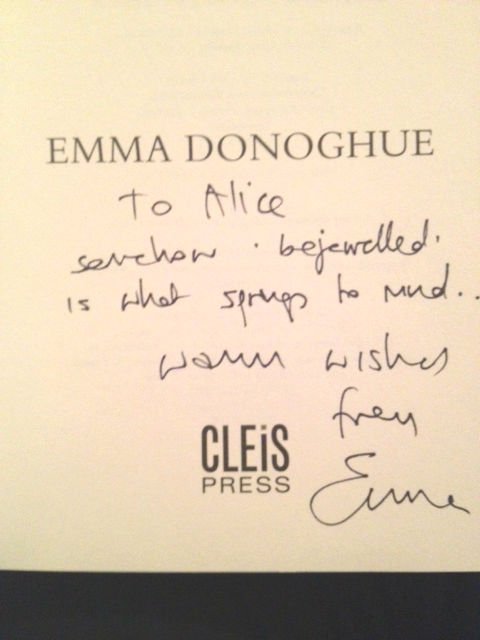
And as is always the case with author signings, I asked her to write one of her favorite words in my book.


Wednesday, March 20, 2013

Diana Victrix: "When people begin to call me conservative, I shall know that I have accomplished something."

A novel from 1897 about feminism and romantic friendship? I would like five tickets for that boat ride, please. So I can EXTRA-enjoy it.

My survey book -- which I'm still in the process of finishing -- about the history of romantic friendship mentions Diana Victrix as an exception to the rule of romantic friendship novels. That rule is that in these novels one or both of the ladies gets married. Always, always always. I mean, they have to! Women can't earn money. Ah, but Florence Converse, 26-year-old Wellesley grad from New Orleans in 1897 says yes, yes they can.


I'm a bit delighted by older books that haven't made the canon, because while we're swayed by The Dudes Who Decided Which Books Should Be Read, they didn't catch nearly everything. And I've got a 14-year-old girl crush on this book. Mainly because it is funny. And has an awesome heroine. And they go HIKING omg. I was not anticipating that, but all of a sudden, the six young people are like "Let's go into the New Hampshire mountains and watch the lunar eclipse and sleep in lean-tos!" and I was like "Propriety?" but apparently it was FINE so that's all okay.


The basic plot is there are two brothers in New Orleans, and they're taking care of their family (well, one of them is, as the other is a lazy dreamer type who's into the arts -- you know how they are) and these two "maiden ladies" from Boston come to stay with the family, as one is ill and they think New Orleans will help her. This seems to be a thing people did a lot in Times That Are Not Now. "Oh, you're sick? A week at the seaside will fix you right up." Why isn't my doctor telling me I require the fresh, wholesome air of the country? I call bullshit on this "medicine" they insist on giving out instead. I would like a parasol and a romantic cough as I walk by the shore, please.

Anyway, so these ladies are New Women, which was a thing at the turn of the century that basically means they thought ladies should be able to vote and maybe be like real people, to which most of the country was like "Whoa now, hold on there, little lady; who's going to be darning my truss if you're out busy voting ALL THE TIME? The maid? The maid doesn't know how I want things darned. So maybe think a little before you go getting all ridiculous. And by 'think' I mean 'be emotional' because thinking isn't how your brains work."

The two ladies (Enid and Sylvia) went to college together and are BFFs 4evs and maybe a little extra. Enid lectures on Socialism in NYC and Sylvia's main job seems to be being delicate, but she's ostensibly a writer too. They're matched up with the two guys -- Jacques, the hardworking one goes for strong Enid, and Jocelin, who sucks, goes for weak Sylvia. Sylvia also kind of goes for Jocelin, whereas Enid's like


Getting into major spoilers, Jacques gets all proposey to Enid, who gives THE BEST RESPONSE EVER, and then he goes a bit Mr Collinsy and is all "Well, I'll propose again later and you'll accept and it'll be awesome" and she's like "Yeah, no, I'm not changing my mind" and he's like "I'LL PROPOSE AGAIN LATER."

And then he does and she still says no and he's upset. And Jocelin proposes to Sylvia, who's kind of like "Whoa," but then he starts crying and she's SERIOUSLY (but internally) like "Oh, I didn't know you were a little girl. Sorry, little girl, I don't marry babies." And then they move back to NYC and Enid lectures more on how awesome Socialism is, and Sylvia writes a book and dedicates it to Enid and everyone's happy except maybe Jacques. And also Jocelin, 'cause he's dead. OH, and also their sister, who burns to death in a fire in a big WTF moment halfway through the book.

I knew I was going to like this book when Jacques as a kid says "I shall punch your head!" to Jocelin.

Enid reminds me of our beloved Marian, if only because the author is clearly in love with her:

Enid was tall and broad and strong; her skin was smooth; her flesh was firm; her eyes were brown and clear, with golden lights in them, like the lights in her hair.

The 1890s were so close to when we had our psyches screwed over by the psychoanalysts that I really can't tell if this book is subconsciously gay or just really Victorian BFFy. Sylvia would at the very least be labeled bi nowadays, but let me offer up some choice Enid scenes:

"The face of the young man who sang haunts me."
Enid gave a little gasp. "That I should live to hear you say you were haunted by the face of a man! " she gurgled indistinctly against her friend's knee; and then, lifting her head, "True! he did have the very largest nose I ever saw."
But Enid had her arms about her, and was saying a great many things very softly in the dark.
"So many pretty women! I was introduced to a lot of men, all more or less uninteresting, rather vapid creatures"
"Don't you think," faltered Sylvia, "that although you have the sorrows of humanity at heart, sometimes you are a little impatient of the sorrows of particular men?"
"Yes," answered Enid; "I do think so, but not of particular women."
She laughed as she said this, and, leaning over, kissed her friend.
"Your loving a woman and my loving a woman are entirely different matters," said Jacques.
"You do not understand," she persisted.
"You would have to come first. And you could not, for she is first."
"And this is all that separates us?" said Jacques, in a tone of entire amazement. "Only a woman?"
"The reason the woman separates us," said Enid, "is because the woman and I understand each other, sympathize with each other, are necessary to each other. And you and I are not. It is not simply her womanliness, it is her friendship. There might be a man who could give me the inspiration, the equalness of sympathy, I find in her, — there might be, — some women find such men. But there are not yet enough for all of us."

That latter quote is from the proposal scene on the side of a mountain, which is pretty damn awesome and you feel BAD for Jacques, because he is a stand-up guy who says things like "When the world and your people hurt you, I will not hurt you: I will believe in you" which just, OMG right? 

And he loves her SO MUCH and is all "Okay, so I don't get Socialism, but I WILL SUPPORT YOU" but she can't do it because she knows it would end her work and be untruthful regarding her friendship and feelings. AGH.

Oh, and, of course, one of my favorite lines (regarding Jacques and another lady):
"I wonder if he is in love with her," mused Enid; "he'd be a delightful person to go out and buy furniture with; he would always be able to get the proper per cent. off. He could drive nails and hang pictures beautifully, but I wonder if he can make love ? Dear me! what is happening to me that I sit up here in broad daylight, and gossip about love and matrimony like a sentimental girl of seventeen, when I ought to be reading Socialism?"

I found a Chicago Tribune book review from 1897 that says, among other things, "its central thought is distinctively new-womanish and Bostonese," "Miss Converse would have us believe that maiden friendship is a higher and more lasting thing than love," and "The story is founded upon false principles--or upon none at all. In either case it is unpleasant."


It's really hard to find an old copy of this book, but I'm going to try. I'm also going to try to work on this time travel thing, because it irritates me TO NO END that I can't have tea with Florence Converse. I did, however, contact the Wellesley library and now have in my possession a record of the courses she took there AS WELL AS a personal information form that she filled out herself. The possession of this caused me to giggle for a good five minutes. Thank you, Wellesley.

Oh, Diana Victrix. More people should read you.

Monday, March 18, 2013

Charlotte Bronte: The Clive Cussler of Victorian Literature

For those unaware, my friend Doug sometimes reviews classic novels that I make him read. His previous awesome reviews that make my normal posts look bad can be found under 'doug reviews things.' This time, he did Jane Eyre. Enjoy.

++++++

I have a problem. I actually liked this book. 'Oh, Doug,' you're no doubt thinking. 'You stupid, sad, fuck-up, you're supposed to like Jane Eyre!' First of all, hey! Secondly, writing reviews of Wuthering Heights and Pride & Prejudice was easy because I absolutely hated the holy hell from both those books. Now I have to write a review without utilizing merciless venom or copious dick jokes. Well, others have done it. Here we go...

I think Nike should come out with a pair of shoes called Eyre Janes.


Um... hmm...


So, here are some characters that sucked all the dick there was to suck. Not Jane, though. That chick fly.


We start off with 10-year-old orphan Jane living with her uncle's widow and her two rat-bastard kids. Her aunt hates the fact she has to raise someone not of her own blood and encourages her kids to ignore her completely. Unfortunately, the boy takes 'ignore her completely' to mean 'dropkick that orphan like she was going for the last slice of pie.' Jane tells on her cousin to his mom and gets in trouble for it.


I want to quickly mention that this is a first-person POV book, and the aunt does keep saying that Jane is a little demon monster from the darkest regions of Satan's Arse-hole. You know, cause they're British. Point is, maybe we're not getting the whole story. I've written to Charlotte Bronte to ask about this, and burnt the letter over a pentagram. It'll get there.


For tattling, Jane gets locked in the room her uncle died in, which is a total mind-fuck. Blah-blah, Jane gets sent to boarding school.


Boarding school sucks, but Jane does manage to make a friend who then quickly dies. In fact, many of the school children die of sickness. This is what is called in the educational system as 'a rough go.' Jane graduates and stays on for a couple more years before deciding to be a live-in tutor.


She moves to Thornfield which is a manor occupied solely by servants and the little French girl who's to be her student. Then the master of the house, Rochester, shows up and he's down to get his aristocratic party on. (But not the cool aristocratic party where everyone wears masks and silently watches two people have awkward sex on an uncomfortable marble blood-altar.)


That donation to Romney was a total waste of a golf
membership. Now I have to golf with Romney. Fuck.

While his guests are staying at Thornfield, Rochester is called away on business. During this time a Jamaican gentleman shows up. Roch-dog returns dressed as a gypsy fortune teller and fucks with his friends by telling them some disturbing shit that they totally secretly believe. Jane goes in and he gets her to admit she's in love with him. This is what is known in the douche-bag system of the 1900s as 'a roofie.' Rochester finds out Jamaican dude is there and politely loses his shit. Then everyone goes to bed.

Middle of the night there's a scream cause one of the servants is crazy and decides to cut up Jamaican dude like a samurai with a piñata full of honor. Jane takes care of him all night and then he gets the hell out of there before anyone wakes up.


Jane and the Rock decide to get married. Jamaican dude shows up and throws a jerked chicken-stained moist towelette on the whole affair cause, whoops, Rochester is already married to his blade-wielding sister that Roch-crusher has been keeping locked up for years because she's cuckoo for coco-arson.


Burn it down! Burn it all
the fuck down!

In an attempt to get Jane to stay, 38-year-old Rochester explains that he's gone through seven or eight 18-year-old girls before deciding that she's the one. For reasons I cannot figure, this did not work.

Jane leaves Thornfield with no money, possessions, or idea where she's going. This is what is known in the real world as 'becoming a hooker.'


She trips across a family of two sisters and a brother who take her in. Eight hundred pages later the brother discovers Jane's true identity and informs her that her long-lost relative died and left her a fortune... and also that they're cousins. Funny how that works.


The brother, named St. John (pronounced retardedly), is a missionary who decides to teach the gospel in India. (Awesome move, bro. You totally didn't dick the future.) He chooses to marry his (goddamn it) cousin Jane. Jane would be all over that hot business, but she feels he loves the Lord more than her and wisely decides to say screw that noise.


Sinjin (yup) verbally abuses the shit out of her for the next month in an effort to get her to marry him. This seems to be a theme in Romantic English literature through the 19th century. This may seem rude, even barbaric, but between cavemen, them, and us, who uses fewer clubs to damage women's brains into hooking up?


Jane tracks down Rochester and finds him to be a hero who saved all of his servant's lives when psycho-wife burned down Thornfield. Did I say hero? 'Cause he winds up with no friends, respect, sight, and only one hand. What a dong.


Jane shows up and vows to take care of him for the rest of his days. Also, St. John dies at 40. It's unexplained why, but it is the last line of the book.


The other characters are unimportant -- even compared to miscellaneous side characters in Wuthering and P&P -- but damn it, they deserve their turn!


Just kidding. I've been writing for 3 hours. Good night.

Friday, March 15, 2013

Harry Potter, The Goblet of Fire: The Finishining

This would've been up last night, but I fell asleep in the middle of html coding. With my laptop in my lap. So here we are.

I'm gonna start actually reading these books next week. I think. Because the last time I tried to read through the series, I'm pretty sure I got stuck in book 5.

Dumbledore. Your office is not very well protected. Come on, sir.

I fricking love the Pensieve. Anytime it shows up, I'm like "SCORE THE BOOK'S ABOUT TO GET WAY AWESOMER THAN IT ALREADY IS." Good job, JKR, on that device. Karkaroff's trial is brilliant, and then...oh, and then. 

There was...a woman with thick, shining dark hair and heavily hooded eyes, who was sitting in the chained chair as though it were a throne.

HEY GIRL

 I belonged to some Facebook group back when those were a thing, that was like "I am intrigued but horrified by Bellatrix Lestrange." Which is the truth. Because she is TERRIBLE, but also one of the best characters. She's Squeaky Fromme in the Manson Family. That is who she is. And I would kill to read about her years at Hogwarts, but SOMEONE ISN'T WRITING THAT APPARENTLY.

You know what's just the trickiest about this section? Is you feel so damn sorry for Barty Crouch, Jr. But no. He sucks. And is insane. And I mean, really, who wouldn't be after years in Azkaban. I think we should all be astonished Bellatrix is as well-adjusted as she is. Let's all hear it for Bellatrix, the witch who surely can reform someday. Surely.

Oh right, Cedric.


I'M REALLY SORRY. I am a cold and callous person. I think when I was 15, maybe I was sad about his death? But I don't remember this. It just happens so quickly! Death seems to happen out of nowhere a lot in Harry Potter, and I get that, JK, 'cause we frequently JUST DON'T KNOW, but it was so sudden and then it's just done, and I was never that into him anywayyyyy, so. Not really sad about him. Sad bout his dad, totally. Not so much him.

But oh, how happy I am that Fred and George got the prize money. And oh, how delighted I am that we're moving onto book 5. So much to talk about. I am excited.


Thursday, March 14, 2013

BEA talk is cheap, but I'll let you know when I've bought a plane ticket

Doug's post on Jane Eyre is coming next week. So be prepared.

I've talked about BEA for about two years now. I've planned on going twice, and twice have my plans been foiled. But HOPEFULLY NOT THIS YEAR. Although I should add that I'm not planning on actually attending BEA: I just want to be in NYC while it's happening so I can go out for milkshakes with book bloggers.


So the current idea is Thursday/Friday/Saturday, leave Sunday. And you know what? I'm seeing the damn Statue of Liberty, and anyone who doesn't want to be a tool can come with, because I've been to New York approximately a billion times, and I've never seen the Statue of Liberty that my, according to my mother, kind of asshole great-grandparents saw when they came over from the Ukraine. FAMILY CONNECTIONS.


But for serious, I'm planning on going. End of May. And I want to meet you all and consume comestibles with you. So save up, fly in, and we can MAYBE have a super-awesome hotel room sleepover which we will get excited about while in the end falling asleep at 11 p.m. in front of a rerun of The Cosby Show.


that's how it's done

Who's going? Or hoping to go? Tell me now, that I might get psyched about this. DO YOU KNOW HOW MUCH I LIKE MEETING PEOPLE BECAUSE IT IS A LOT.

Tuesday, March 12, 2013

Surpassing the Love of Men

Yeah. The title. I know.

Surpassing the Love of Men: Romantic Friendship & Love Between Women from the Renaissance to the Present was published in 1981, at a time when there was something of a feminist pushback. A pushback and a lot of defensiveness. I'd like to add that this is not the case in the book itself so much, because she tries hard not to use 20th century ideas when dealing with previous centuries. Quite the opposite, in fact: Lillian Faderman has been criticized by more recent scholars for NOT assuming things about historical relationships between women.

yeah, assuming that thing.

This is part I because it's over 400 pages, and is an ENORMOUS historical/literary survey (and completely awesome) and if I did just one post on it, that post would be obnoxiously long. I'm hoping to split it into two, if I feel like doing the more emotional side of things.

The book begins in the 16th and 17th centuries, discussing how there was essentially no notion of lesbianism because, psh, what could two women do together? But then there's a rather terrifying section discussing how women who dressed as men and disguised themselves for whatever reason they had (it's assumed this was at least partially to, y'know, 'have a job') were hanged, whipped or burned. 'Cause two women play-acting at a sexual relationship is hilarious, but when one of them pretends to be a man, well. Those're MY rights to own land and people, damnit.

The main criticism of Faderman's book, which she addresses in her new intro, is that she frequently states that the relationship between women in a romantic friendship was most probably not sexual. People take umbrage at this, and I get it. I do. But as she says, her point was not that it COULDN'T have been; it's that it doesn't so much matter:
"The point I wished to make was that whether or not we can find specific evidence that the women in question had genital sex together, their intense emotional and erotic (i.e. sensual) attachments to each other qualify them as foremothers of contemporary lesbian-feminists."

Let's just ignore how gross the term 'genital sex' is and focus on the intense emotional attachments women had for each other in previous centuries. Because damn, did they.

like these cats


And there are so many reasons why. One of the primary ones is that men and women moved in completely different spheres from childhood onwards. They tended to regard each other as almost different species, and sure, you'd marry each other, but true understanding and friendship? That was with your own sex. This is more in the 17th century, but separate spheres were maintained through much of the 19th. So okay. You're a lady. At a school with other ladies. And you meet another lady who is the GREATEST, and because she is awesome and you're awesome, you figure wouldn't it be great if you didn't have to get married to a terrifying and seemingly alien man and instead could move to a cottage in Wales and have important Literary Figures of the Day over for tea?

Because that's what the Ladies of Llangollen did.  And it wasn't seen as all that weird. Because it was the late 18th/early 19th century. They were allowed because they were an anomaly. Most women couldn't support themselves and had to marry. Their intense female friendships were seen as permissible because said friendships were, as Longfellow said, "a rehearsal in girlhood of the great drama of woman's life" (asshole).

Since they were no threat to men, they were indulged. Women spoke openly of their passion for each other because it wasn't seen as sick or unusual, or necessarily implying a sexual relationship. So you have novelist Charles Brockden Brown writing a 1700s epistolary novel about two girls, where one says to the other:

"What I feel for you I have not felt since I was sixteen, yet it cannot you know be love. Yet is there such a difference brought about by mere sex—my Sophia's qualities are such as I would doat upon in man. Just the same would win my whole heart; where then is the difference? On my word, Sophia, I see none." 

Faderman says that Freud fucked all this up.

Well. Freud and the 19th century sexologists (lookin' at you, Krafft-Ebing).

People in the early 1900s, beginning in Germany and France, became intensely self-aware, got into psychoanalysis, and started viewing closeness between women with suspicion. This, of course, coincided with the comparative ease with which women could now be self-supporting, thus rendering marriage unnecessary for them.

Literature turned from the sweetness and beauty of female friendships, to painting the same type of relationship as a disease:

"On the Continent, however, and to a lesser extent in England, where literature about evil lesbians was all the rage and where hundreds of doctors were turning their attention to the disease of love between women, the perception of romantic friendship as a noble institution which society had no reason to discourage and every reason to encourage, was quite dead by the end of the nineteenth century." 

This particularly angers me:

 "One wonders how many romantic friends who had felt themselves to be perfectly healthy before, suddenly saw themselves as sick, even though their behavior had in no way changed, as a result of the sexologists' formulations." 

 When this book was published, homosexuality had only been off the American Psychiatric Association's list of mental disorders for eight years. Eight. That's like 2005 for us. And even though there's still debate (put forward by Certain Groups) about it today, this wasn't even a question until about 130 years ago. Which brings us to cultural doxa again. We have been raised KNOWING things are right because — well, because they're things everyone knows. It's just how it is. But what 'everyone knows' in our time is completely different from how those in 1750 would feel.

Even in 1890, with their 'new awareness,' they still allowed some relationships to pass unchecked, because a lesbian was 
"usually of a masculine type, or if she presented none of the 'characteristics' of the male, was a subject of pelvic disorder, with scanty menstruation, and was more or less hysterical or insane."


So if you weren't like that, and merely like Enid in the 1897 novel Diana Victrix, who, while with her romantic friend Sylvia, "had her arms about her and was saying a great many things very softly in the dark," you were a-okay. Yeah.

ESSENTIALLY, ladies have almost always been able to have longterm, passionate friendships with each other, with a blurred line between the erotic and the platonic. And no one really cared before 1900. But our 20th century obsession with labeling things both gave lesbians a more solid sense of themselves AND screwed over super-close friendships for women, because according to the new model, it's either sexual or it isn't, and if it is at all, let's make a giant deal about it.

I love surveys. I love history. I love ladies. And this was a giant historical survey about ladies. Two very enthusiastic thumbs up. Fine holiday fun.

Monday, March 11, 2013

More books I'm barely reading (FEEL the excitement)

I am officially reading an insane number of books. I don't know when it got this out of hand. I suspect early January. I have one book I'm technically ACTUALLY reading, and then five billion others (slight exaggeration possibly) I'm picking up at random intervals. So this being my blog where I talk about unfinished books, let's look at some of them:

Lamb, Christopher Moore. Ah, recommended by Alley and then forcibly lent me by someone (for reals, we didn't discuss it; he didn't ask; it was just shoved at me). I'm...liking it? Yes. I am liking it thus far. But I am not very far.


Surpassing the Love of Men, Lillian Faderman. Right. This book. How to explain this book. The title is awful, but it's a product of the 1970s and WE WERE FEELING A LITTLE DEFENSIVE OK. I actually passed this book with an eye-roll about ten times at the library before I found out that 1) Lillian Faderman is the best, and 2) Oh, it's actually a historical/literary survey of romantic friendship from the Renaissance to the present and AMAZING. I just try to shield the cover when I'm on the train.

Oscar Wilde's Last Stand, Philip Hoare. This was recommended to me by the awesome Jenny of Jenny's Books. If you don't know her blog, you should go there now. (p.s. Alley I love you, too, but everyone here knows you) It's about a trial NOT of Oscar Wilde, 'cause he be dead already, but concerning him. I have been assured the trial is the sensational-est, which is helping me get through the author's occasionally ridiculous prose. I haven't gotten to the trial yet, but it IS giving a nice general summary of England from around 1910-1920. Summary thus far: everything was fun and then everything was not fun.

Diana Victrix, Florence Converse. A novel from 1897 concerning romantic friendship, mentioned in Surpassing. Contains my favorite line, "I shall punch your head!", as well as "I prefer a woman who has not quite so markedly the figure of a cotton-bale." Florence Converse, I wish you were still alive so we might go to tea.

Anna and the French Kiss, Stephanie Perkins. You know what, the cover for this is not great. But I was told by someone I respect to ignore that aspect, and it is actually quite excellent. The opening paragraph is stellar and made me fond of the narrator, so good job, Perkins. Hopefully the novel continues to be good after the first two chapters, for that is all I've read.

And then...others. I went to the library yesterday, for I am dumb. When I finish Surpassing, I have Inseparable by Emma Donoghue, as well as her Passions Between Women, which I suspect will overlap a bit with Surpassing. I actually started it, but she contests some of Faderman's theories, so I was like "Well, I guess I should read HER book first."

I'm terrified of writing my post(s) on Surpassing, mainly because -- remember my review on a history of heterosexuality? Yeah. That book was like 150 pages, and I was still like "Omggg I'm not going to be able to say everything I need to say." This book is 415 pages. And covers so....so very much. So I'll probably split it into 1) A summary of some things and then 2) More feelingsy type stuff. 

One quote from it, about Revolutionary War soldier Deborah Sampson: Deborah decided to enlist in the army in earnest...because her mother had been urging her to marry a young man whom Deborah described in her manuscript memoir as 'having the silliness of a baboon.'

Good stuff.

Thursday, March 7, 2013

Harry Potter Readalong: Harry Potter's Secret Heartache

I was seriously just screencapping the trailer to Joss Whedon's Much Ado About Nothing and preparing for bed when I realized it's basically Harry Potter Post Day, which made me go "Fuck" and now this is what you're getting, because I have to go to sleep in like five minutes.

Cho Chang. Don't we all hate Cho Chang? I did, anyway. Because I was 14 and Harry was clearly fated to be with Ginny because she LIKED him, and thusly had my sympathy.


stop being you, Chang. just stop.

The Yule Ball. And the subsequent Best Fight for a While Now. I specifically remember marathoning this book at the same time as my Ron-and-Hermione-ship-doubting friend, immediately post-release, and when I got to "he somehow thought that Hermione had gotten the point much better than Ron had," I phoned her and launched into "I TOLD YOU. I TOOOOOLD YOU" only to discover she was about 20 pages behind. Don't spoil your friends, kids.

*skims some more*


Rita Skeeter's smile flickered very slightly — I love that shit. Every time. People use it and it always makes me happy.

The weird gay bathroom — I seriously think I only think of it this way because he's naked. And it has a hundred wicked-awesome golden taps with inset jewels. Did I mention I love baths? They are the best. We got one of those 'cover up the drainy thing on the side that's supposed to stop the bath from overflowing but really just makes it so your bath is never awesomely high enough' things from Bed, Bath and Beyond for the apartment and it's the most wonderful invention ever. Anyway. This bath is probably the best of all baths, but also, do the prefects have different bathrooms, or is it unisex? Because I call SHENANIGANS on that.


I love the Second Task SO HARD.


The Lestranges — they're a married couple — they're in Azkaban. — *giggles* *rubs hands*


Bertha Jorkins makes me very, very sad.


Julius Caesar: Let's just change the title to 'Brutus'

I saw Julius Caesar last night with my delightful playwright friend Skye.

indeed.

So I went into this knowing nothing about the shape of the play. So when Caesar gets stabbed in Act I (surpriiiise!), I was all "Whoa. What happens now?" Especially since I saw Elizabeth Taylor in Cleopatra and in THAT, after the boring Rex Harrison-as-Caesar part is over, she has awesome sexytimes with Marc Antony. But she's not even in this play. Boo.

Instead, Antony's all "DAMN YOU BRUTUS" and tries to exact vengeance upon all the Caesar stabby dudes, but when they're all dead because Octavius shot most of them (it was updated to modern times), he's like "DAMNIT Octavius. Brutus was AWESOME. He was awesome and you're a dick." And I'm like "Omg Antony make up your mind, because you just spent all this time asking people to lend you their ears and assorted body parts to make them hate Brutus and now you want to make out with him but he's dead so your timing is terrible."

Chicago Shakespeare Theater did a kickass production of this play. It's modern. They had a banner for re-electing Caesar, with a website address (look at you!). It's not their fault Shakespeare basically gave up in Act II and was like "Fuck it, just -- just -- everyone dies." There were some pretty awesome sequences involving a set with an overturned car, and smoke and people running around avoiding gunfire, and soldiers RAPPELLING FROM THE CEILING, which was the coolest. 

But yeah, Act I is like "Intelligence! Character!" and Act II is like "Boom! Pow! Bam!"

I like how Shakespeare does one of those Johnson/Boswell, Pale Fire-type things where it's like "This is about X character." But awwwwwwwww no it's not. Because Julius Caesar is alllll about Brutus. Caesar's barely IN it. Did you know that? I did not. And in Act I of this production, Brutus and Cassius were walkin' around wearing suits and looking super-fine while discussing how Rome cannot maintain its identity if Caesar is crowned, and I was all "Yeah! I side with you, fine-looking men!" Liberty, freedom and enfranchisement! (enfranchisement? that's kind of a wordfail, Shakespeare)

Julius Caesar:


Act I is also the best because Brutus's wife Portia gets some badass speeches. EXAMPLE:

Is it excepted I should know no secrets
That appertain to you? Am I yourself
But, as it were, in sort or limitation,
To keep with you at meals, comfort your bed,
And talk to you sometimes? Dwell I but in the suburbs
Of your good pleasure? If it be no more,
Portia is Brutus' harlot, not his wife.


DWELL I BUT IN THE SUBURBS OF YOUR GOOD PLEASURE. I think I hit Skye in excitement over that line. That is damn good writing, Shakespeare. (Shakespeare: "Hey, thanks." me: "No probs")


Anyway yeah, so Brutus and Portia were super-hot and awesome in their basically one scene together, and I was all "I will captain this ship" but then in Act II -- when they're at war with Antony -- Cassius and Brutus are talking, and Brutus totes caj-like says "Portia is dead." AND THEN THEY MOVE ON. Later, some messenger comes in and says Portia is dead, which is....weird, because they already...said that. But okay.

After Portia dies, it's even more about Cassius and Brutus, and...I get it, guys. I get it.


As with all Shakespeare, I phased out during some of the speeches, but as Skye said "As long as you come back for the end, you're ok." I was unexpectedly and highly entertained/moved/generally made to feel feelings during this play. So good job, Shakes. Too bad your revolution thing didn't work out, Roman guys, but instead resulted in this:


You tried.

Wednesday, March 6, 2013

Claude Frollo isn't QUITE as horrible as he looks. But it's close.

I'm going to yet again bring up the Tiredness Annoyance. Which is that if someone says to you "Man, I'm just really tired," you do not reply with "Yeah, me too." Ever. Because everyone is tired except those of us on cocaine. So yeah. We know.

The way you respond to someone saying they're tired is "I'm sorry, dude" or "That sucks." Unless it's like the queen. Then you say "That sucks, YOUR MAJESTY." Because what that person is saying is "Today is hard for me." And by you responding with "Oh I'm TOTALLY tired too," you're basically saying "I don't care about today being hard for you; let's talk about me." Just FYI.


False, Regina. False.

IN OTHER NEWS, Claude Frollo. What a bastard, right? And SUPER-creepy. Thanks, Disney. But it's not just Disney. It's Victor Hugo. Frollo swoops like a big molesty bat at Esmeralda in one scene of Notre Dame de Paris (which I was supposed to finish for my Balzac/Hugo class in college and sorta never did, but whatevs, it's fine) and is generally just rockin' a rapey vibe of grossness. Which is maybe why that Disney movie doesn't get a lot of play, despite it being super-awesome.

However. There's a thing Disney changed, and I'd like to take a sec to defend Creepy McNasty. Because in the tremendously great opening song of the movie, 'The Bells of Notre Dame,' they indicate that Frollo:


1) Causes the death of Quasimodo's gypsy mother who was trying to save him


2) Tries to throw the baby hunchback down a well because he's "a monster"


EHHHHHH. WRONG. If memory serves, the baby was left in some kind of...abandoned baby trough (I read this in French and have to translate, just go with it) by the church, and the townspeople are all "WTF let's kill it" and Frollo's like "BACK! BACK ALL OF YOU" and saves the baby in an attempt to attain salvation for his brother by proxy? I don't know. It was weird. But I know he saves Quasimodo and raises him without some priest having to be all "Seeeeeee there the innocent blood you have spilt/On the steps of Notre Daaaame." So let's all be 2% nicer to Frollo. Because he was still super-gross and mean to the Gypsy population, but he didn't try to kill a deformed baby. So that's something.