Friday, October 30, 2015

There're a lot of kickass books out right now

Do you feel like there have been more great books coming out lately than normal? Like a weird abundance? 

There are so many amazing books out right now and I haven't been able to get through any of them or even start some of them. But let's talk about them really quick, because that'll make me feel like I am somehow making progress when I am in fact not doing that at all.

Drood by Dan Simmons. Some of you hate this. But it stars Charles Dickens and Wilkie Collins and involves The Mystery of Edwin Drood which I love SO MUCH so even though it's the size of a small elephant, I want to read it.

I miss Drood, guys.

The Thrilling Adventures of Lovelace and Babbage by Sydney Padua. I mean. It's a comic about Lord Byron's daughter Ada Lovelace and how she basically invented the first computer. What exciting times we live in!

The Scarlet Sisters: Sex, Suffrage, and Scandal in the Gilded Age by Myra MacPherson. I recently listened to a Stuff You Missed in History Class podcast about Victoria Woodhull and I have decided perhaps I have been too harsh on her. So I am THE MOST looking forward to reading this and cherishing it forever.

Look how great this cover is!

Furiously Happy by Jenny Lawson. I was eh about Jenny Lawson's first book, but I still very much like her and want to like her books. So I pre-ordered this and then forgot I did, so it surprise-arrived in the mail the other week. I have not read any of it because I am BUSY.

Crimson Peak the Novelization by Nancy Holder. I love the pants off this movie, so I spent five bucks on the novelization and will be reviewing the shit out of it, because MOVIE NOVELIZATIONS.


The Witches by Stacy Schiff. Little, Brown sent me this AGES AGO and Halloween's tomorrow and I haven't read it. I very much want to. I mean it's an intelligent and excellent writer talking about the Salem Witch Trials, a topic everybody is interested in, and yet nope. Guess how many episodes of The Office I've seen lately though? Well, don't guess, but it's a lot.


Sandman Volume Six by Neil Gaiman. I would love to continue the Sandman series. I love the Sandman series. And yet I have been on volume 6 for appx one million years. 

Those are the main ones. I want to read Mindy Kaling's new book, but that's probably not gonna happen until Christmas. Here's what I always say to this sort of dilemma though, because it's gonna be one that everyone who reads has gotta face sometime in life: it's better to have too much to read than too little. So just revel in the TREMENDOUS WEALTH created by your fellow man and how at the very least, there's always gonna be more you want to read. 

Wednesday, October 28, 2015

Monkalong: The Final Monkening

You guys. When Antonia died because of course she did since she'd been raped, this is exactly what I said to Matthew Gregory Lewis:


"WHAT DO I DO WITH THIS NOW USELESS WOMAN?" Lewis cried. "Oh, I'll just have her get murdered, 'cause since one dude violated her with his dick, now no one else can have her. She is literally ruined. I know it's 'technically' not her fault, but I think we all know it's her fault."


Antonia's dead, Matilda was a demon the whole time, and Satan threw shade at Ambrosio.

"Scarcely could I propose crimes so quick as you performed them."

#SatanShade

WHAT TO EVEN THINK OF THIS BOOK. It's just a giant exercise in "let's feel superior about Catholicism and also write the most salacious things possible." But! It's semi-famous and people still publish it. And now we know what, like, 50 Shades of Grey was in 1796. 

You know what else was published in 1796? Fanny Burney's Camilla and Jane West's tracts written as "Prudentia Homespun." So basically we probably should've read those. Except THOSE don't end with Satan flying a monk over a river and dropping him next to it so all his bones break and insects eat him. Or so I would assume.

This book was bonkers. I'm glad we read it.


Also HAPPY BIRTHDAY MEGS I love you tons and I'm sorry you had to read about demon nuns right before your birthday. OR AM I?

Monday, October 26, 2015

Once Upon a Time: Swan Queen is the little ship that could (but won't)

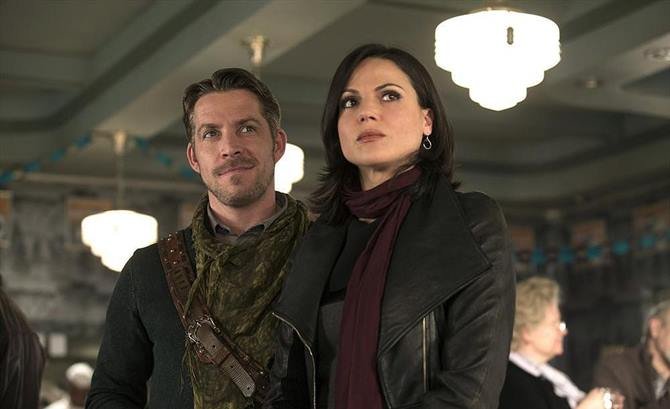
I normally keep my feelings about Swan Queen aka Emma and Regina on the terrible ABC show Once Upon a Time out of this space, because BOOKS and so forth, but last night's episode (that I didn't watch but saw recaps of on Tumblr) was the Swan Queeniest and I can't handle that this show, after five seasons, still has not put these two women together.


Yeeeeah....

If any of these scenes had happened with a guy and a girl, the audience would be clamoring for them to get together, but because it's between two women, the Swan Queen fandom has to deal with a ridiculous amount of harassment and negativity. It took ages to even get the show's creators to acknowledge Swan Queen as a thing, which is ridiculous because it's definitely the most active fanbase for the show (#motivatedlesbians). 

Even if you ignore the size of the fandom, the way the show has structured Emma and Regina's frequently combative relationship is textbook for enemies who end up banging. Let's see, new sheriff comes to town, challenges the lady mayor, it turns out they share a son who the mayor had adopted, they save each other's lives numerous times, NOPE NO ONE EVER WOULD BE SHIPPING THAT THAT IS RIDICULOUS, ALICE.


This show's not even good, but the immense possibilities between Emma and Regina keep me invested in a ship that will probably never happen due to damn heteronormativity. THE TWO WOMEN ARE LITERALLY INVOLVED WITH BEARDS.

Beard 1
Beard 2

This show has done an enormous amount of queerbaiting (what else do you call a woman asking how she can get her "nemesis" to "taste her forbidden fruit") and I'm sick of it, but if you're invested in the pairing, you basically have to grin and bear it. I stopped watching the show two seasons ago when the season finale was The Emma and Hook Variety Hour and I spent 15 minutes after it ranting on the phone to my friend. BUT I AM OBVS STILL VERY INVOLVED.

The Swan Queen fandom is amazing and full of optimistic idiots. That should probably be our subheading: "SWEN: Optimistic Idiots." 


COME ON.

Emma and Regina have the most developed dynamic on this whole damn show, and them coming together would make total sense with the plotline they've been building for five seasons. But it 95% won't happen, because they're both women. I'd say I'm done with this ship forever, but that will never happen. Thanks, show. Thanks.

Wednesday, October 21, 2015

The Monkalong, Week IV: What kind of crazy shit goes on in Denmark?


What've we learned from The Monk this week. You allow a lady disguised as a dude to live at your monastery and soon enough you and her are banging 24/7, you're making pacts with Satan and murdering older ladies with pillows.

Ambrosio! What a d-bag. What, sir, so your new awesome plan is to AGAIN DRUG ANTONIA and keep her prisoner in some underground crypt sex chamber? That's gonna get real boring real fast, and also, ew. You are terrible at life, and I do not like you.

AND WHAT WAS UP WITH CHAPTER III OMG. All the things happened in Chapter III!!! The Prioress's evilness is discovered! She is horribly mutilated and murdered by a mob. A secret chamber is discovered at the base of a statue! Agnes is found! And now they're running around like at the end of Phantom of the Opera and searching for the seemingly-dead Antonia (I assume) in the near-endless caverns. Don't tell me you didn't listen to the end tracks of Phantom or even think about them while reading this.

I have a really déclassé joke for this, but it would shame my mother

Unexpected props go to this line:

But the Ghost interrupting me uttered three loud groans, and roared out in a terrible voice, "Oh! That Chicken's wing! My poor soul suffers for it!"
Totally threw me. I thought it was a for serious ghost recounting and all of a sudden it was a That'll Teach 'Em to Eat Chicken on Fridays lesson.

Next week's the last post! It came up so quickly! How're you guys feeling? You glad we read this weirdass book? I hope so, because I think at the least you can be at a party and be like "Hey, so also there's this 18th century book about a lecherous monk who makes pacts with Lucifer and roofies a lady with a myrtle branch and how about we talk about THAT for five minutes."

The Maze Runner: Everything that usually happens in a dystopian YA book but that we always like

There is one girl in this book. And I liked it anyway.


That girl is also IN A COMA FOR OVER HALF THE BOOK. 

So, for those of you who also somehow avoided the plot of The Maze Runner until the end of 2015, it's like Lord of the Flies but with everyone being nice and polite (except maybe like two people. and also there's a maze). You (the main character, also known as Thomas) wake up disoriented in a metal box, which ends up opening in a big field called the Glade, which turns out to be....dun dun dunnn IN THE MIDDLE OF A GIANT MAZE. And there are runners who run through the maze. Will Thomas become a maze runner?? Probably!

This was awesome to read while working through harder stuff. It's eminently skimmable and the end feels like it actually needs a trilogy (or however many are in the series so far; I know it's more than three), because the story James Dashner is telling needs more than one book. 

Why are they in the maze! Who built it! Is there a way out! What're those creepy monsters inside it! And seriously how does Dashner get away with having 99.8% dudes in this book.


I didn't want to read it at all until I saw the movie trailer and I was basically like "Ooh those walls are super-big."

Oooooh.

Dashner does a good job with diversity without making it seem like he's trying to have diversity. Which seems like a step forward in general for authors just portraying the world as it is. And I personally am grateful, because I'm looking forward to watching Minho in the movie. Mmm, Minho.


Yes, Thomas the Main Character is a carrier of Special Snowflake syndrome, but it's not overdone. So he's "The Best Maze Runner of All Maze Runners!!!" but it's kind of okay because he doesn't know why, because -- oh yes -- EVERYONE IN THE MAZE HAS AMNESIA. So they know what their names are and what objects in the world are, but they don't remember their personal histories at all. It's fine. Just go with it.

It's YA dystopian fiction. The world's probably gone to shit outside the maze, but exactly how isn't made totally clear by the end of the first book. There's also a big mystery that The Only Girl's involved in that I very much want to know the answer to, so I'm going to read the others in the series. For that reason. And also because I like groups of people working together. 


You can probably get copies at a library sale for like 25 cents, so I'd say go for it. Then we can talk about how great Minho is (by which I mean, he's a badass with big arm muscles, because no one really gets Character Developed in this book). 

The Maze Runner, I didn't think I'd like you, but you were surprisingly interesting.

Monday, October 19, 2015

Lafayette in the Somewhat United States by Sarah Vowell

Two weeks after finishing Sarah Vowell's latest book, Lafayette in the Somewhat United States, I'm trying to figure out why she wrote it. It certainly isn't for the reason many girls ages 14 to 35 will read it -- obsession with the Broadway musical Hamilton and a new desire to read about America's favorite fighting Frenchman ("Lafa-yette!") -- so why?

...there will be many Hamilton references today

Vowell states that in 2003, when France "refused to back an American resolution for military action against Iraq," thus ensuring the unfortunate emergence of "freedom fries," she stopped at a house museum where Melville wrote Moby-Dick while she was attending a wedding (sounds like a pretty Vowellian move), and she noticed a tiny silk dress on display that Melville's wife wore as a two-year-old when she was "presented to the Marquis de Lafayette" on a return visit of his to Boston. She was struck by how this apparently meant so much to the family, they kept the dress and the story surrounding it.


I find myself slightly dubious about that starting an entire book, but I suppose one of the questions Vowell came into it wanting to answer was "How beloved was Lafayette?" (answer: really, really, really beloved)

While I love all of Sarah Vowell's books, and this is definitely readable and fun and interesting and taught me more about the Revolutionary War (I now have a pretty damn good grasp of what the hell happened at Yorktown, which makes me feel like less of an idiot about my own country), I feel dissatisfied with a real understanding of why people loved Lafayette so much. 


NOT REALLY, NO (x)


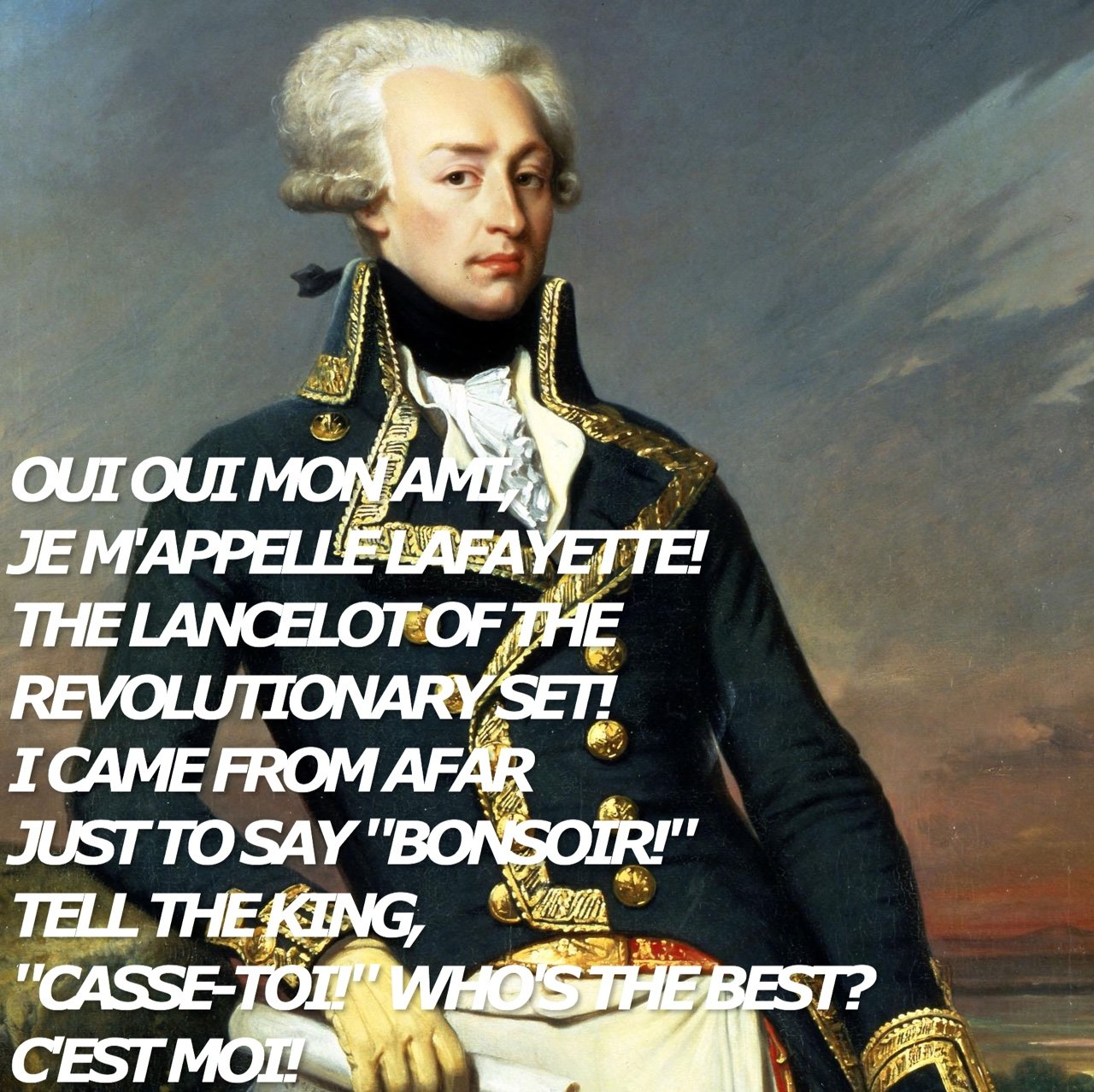
Lafayette, in brief, was a 19-year-old extremely rich French noble who wanted to fight in a war. And France, weirdly enough, had nothing to offer him in the late 1770s, so he ran away to America and volunteered to fight for us for free. We couldn't even afford shoes, so we said okey dokey.

The portrait Vowell paints of him is, I will say, adorable. Imagine a really excited puppy who very much wants to fight the British, and you have Lafayette.


Lafayette with George Washington

He was insanely positive and loved America a lot. Like...probably more than we do. Not that he wasn't into his own country. He was also pretty damn instrumental in getting France to essentially win the war for us by sending money, guns, ships, and troops. And Baron von Steuben! The French Minister of War introduced him to Benjamin Franklin, and von Steuben proceeded to make us look like actual soldiers instead of a bunch of guys standing around.


MAYBE

While I don't think I necessarily got the information that would explain why 2/3 of New York came out to greet Lafayette when he returned to the U.S. in 1824 (I mean, other foreigners helped us out, LIKE VON STEUBEN), Vowell as usual takes you through various historical sites, makes you hella want to visit them, AND gives a pretty good overview of the subject she's covering in a limited amount of space, as she seems pretty committed to books that are fewer than 300 pages.

I came out of it with the aforementioned Yorktown info, a better appreciation for what we owe the French for the 1770s, a greater knowledge of the role key figures played in the Revolutionary War, and a burning desire to have something etched with the words spoken in France by Colonel Charles E. Stanton when America entered World War I:

"Lafayette, we are here."


My face every time I come across that story
So, read it. Learn things. Listen to Hamilton.


Wednesday, October 14, 2015

Monkalong III: So much talk of delights in people's bosoms


I'M SORRY FOR ENDING THE READING THERE I DIDN'T KNOW.

You better fix this, Monk. Holy shit. 


So basically, in this section, the monk Ambrosio and Matilda bang a lot, then he immediately gets sick of her because she's too slutty (MEN), then after talking to her for 10 seconds he's really into Antonia who we're all assuming is his sister, and now Matilda's summoned Lucifer to help Ambrosio roofie Antonia with a myrtle branch and maybe rape her.

WHY DIDN'T WE ALL READ IVANHOE INSTEAD


Positives from this section:

1. Antonia's mother Elvira is a badass and somehow defies Lewis's usual disgust with women over 18 by being clever and prudent and awesome. Instead of throwing Ambrosio out the second she realizes he was making sexual advances towards her daughter, she uses grace and tact to get him the hell out of her house. It is spectacularly done.

2. The silver mirror that Matilda was given by her enslaved fallen angel is a smartphone.

A confused mixture of colours and images presented themselves to the Friar's eyes, which at length arranging themselves in their proper places, He beheld in miniature Antonia's lovely form.

Next time I FaceTime with someone I'm gonna be like "Behold in miniature your lovely form!"

3. The poems don't seem necessary to the plot, which is great, because I'm pretty sure nobody's reading them.

4. Elvira wrote out the entire Bible but omitted "improper passages"? I mean, yeah, the Bible has some super-gross stuff, but even barring the whole censorship idea, do you know how LONG that would take? SO LONG. I can't tell if I'm impressed or pissed about the censoring thing.

5.   
Every evening she was seen straying upon the Banks of a rivulet by Moonlight; and she declared herself a violent Admirer of murmuring Streams and Nightingales
 Ahahaha yes, make fun of all the Romantics, Lewis.

6. Ambrosio's overly intense romanticizing of Antonia's virtues after almost no acquaintance with her totally rings true to 17-year-old me, and I'm pretty sure 19-year-old Lewis was drawing this from his and his friends' experiences. One summer my family was vacationing in Chautauqua, NY, and I had a massive crush on one of the young artists at the opera house, despite this being appx nine years prior to coming out. I wanted her to ask for something like a glass of water from a mile away so I could run out and get it for her. Because teenagers are idiots. And Ambrosio's at the emotional/sexual level of a teenager, so there we go.

7. With the "the modest girl wins the man in the long run," which I think is a simplified version of what Lewis is doing here (since after a while Ambrosio wants to rape her anyway) -- is the 'give it all away and they won't want you' cliché just legit how we are as a species? Is it a cultural thing? Are there benefits to it? I just don't know.

Link up below.

More bustles and corsets, please

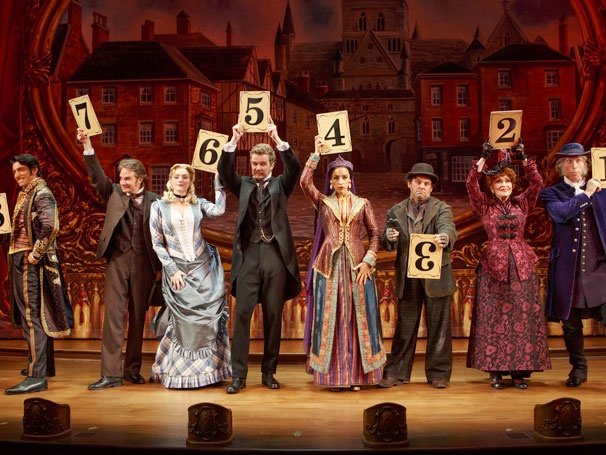
I recently saw the musical A Gentleman's Guide to Love and Murder, which is based on the Criterion Collection film Kind Hearts and Coronets (starring a young Alec Guinness), which is in turn LOOSELY based on a 1907 novel named Israel Rank: The Autobiography of a Criminal. The musical was fairly adorable and twee, but not my favorite ever. AND YET, this morning at 6 AM I found myself on AO3 reading the scant offerings fanfic writers have decided to dedicate to it. I have thought about it and decided this is entirely due to the dresses of the 1900s.
 
From the only number in the show anyone cares about: 'I've Decided to Marry You'

There are TWO main women in the show, and the way their rivalry is decided is delightful (I shall be reading the book to see what happens there). They also both have fantastic dresses. At this point, it seems if you put a lady in a dress anywhere from the 1870s to 1910, I will watch whatever she's in. Unless that woman is Keira Knightley, because I am done with her being cast in All Things Period and SHE'S NOT EVEN THAT GOOD cast other people omggg.


STOP RUINING THINGS I LOVE
The plot of Gentleman's Guide in a nutshell is that an impoverished young man learns his disinherited mother belonged to a noble family, and if he kills eight or so people, he will inherit all their things. So he starts knocking them off in ingenious ways and also falls in love with two ladies. It is entertaining.

The other musical that obviously came to mind when I was thinking this bustle/corset situation over was The Mystery of Edwin Drood. Do you all remember that, because I definitely, certainly, beyond all doubt wrote a few things about it.


I also might have liked Rosa Bud/Helena Landless a lot YES THERE IS A PATTERN I KNOW IT

If you set your musical anywhere in this 40 year timespan, I will see it and probably make some tumblr gifsets about it, because good lord, more bustles and corsets in the world. Onstage, that is. Not on regular ladies walking around, because feminism, etc etc, but ON THE STAGE it is okay because you are representing a time when ladies were more restricted by The Man (but also looked really good, let's admit it).

So! Does anyone know books with two ladies who're either friends or rivals that take place during this time? And DON'T suggest anything by Edith Wharton -- I think yesterday's post made it clear that I'm all up on the Countess Olenska and sad sad May Whosy and what happens with them. What about that one lady who wrote romance-type novels but they're supposed to be good? When're those set? And how do you pronounce her last name because I still can't say it with confidence.

Tuesday, October 13, 2015

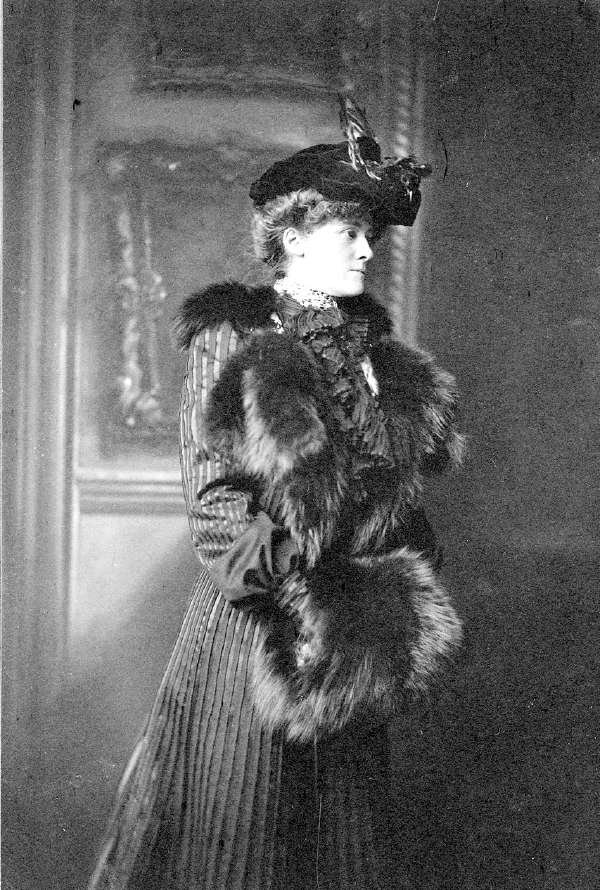
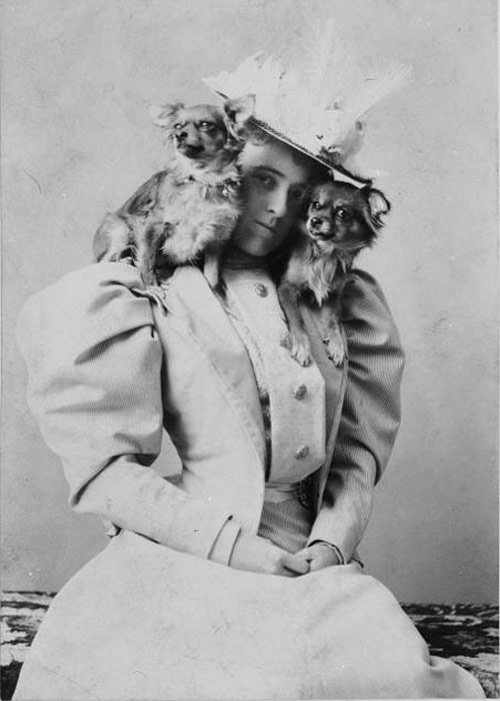
5 Times Edith Wharton Looked Pimpin'

Starting it off with some ruffle layering, nice, nice. She doesn't seem too into it, but she knows she looks awesome and that the bustle's working for her.

DAMN let's examine this photograph. Not only does she look like she wants to get the hell out of this picture, her corset's kickass, the stripes on her skirt are A to the +, her gloves make her look like a lady, and she's leaning on some random banister FESTOONED with things. Who gazes off into the distance with a slightly pained expression (could be the corset) while wearing an outfit that awesome? Edith Wharton. She is done. She is over it. She will write a withering short story about this incident later this evening because she can.

I CAN'T EVEN WITH THIS. Wtf is up with her dress! And then she's got her hands in a muff the size of a wolverine! Who can pull that off -- Edith Wharton can.

Omg. Do I even need to talk about this? Because this is turn-of-the-century classic author and brilliant human Edith Wharton with two Chihuahuas on her shoulders.

And this last one goes up because it's the happiest photo I've seen of her, and she's in an academic setting AND older, and the fact she is happy for both of those makes this THE PIMPIN'EST OF THEM ALL.

Friday, October 9, 2015

The Creation of Patriarchy by Gerda Lerner - A book I am choosing to read

Do we all know who Gerda Lerner is? No, of course we don't. Gerda Lerner was a feminist historian who said some really kickass things, and whom I discovered through the glory that is Tumblr.

The whole wonderful gifset is here, but here's its essence:


WHY WOULDN'T YOU WANT TO READ A BOOK BY THAT LADY.

So in 1986, she published the first of two volumes, The Creation of Patriarchy. Ever since reading Hanne Blank's completely wonderful Straight: A Surprisingly Short History of Heterosexuality, I've been extremely interested in the idea of 'doxa' or 'this is right because it's how things are and how everyone knows it should be.' WHICH IS A CULTURAL CONSTRUCT.

Gerda Lerner looked at how our culture is set up and HAS been set up for millennia and said "Well, I wonder if we can trace the roots of patriarchy," and then she spent seven years researching and writing a book about it. A lot of which centers around Mesopotamia, because apparently there's a ton of information out there about Mesopotamia?

Um, apparently this is where Mesopotamia was

I'm only on chapter 2, but on the "How Academically-Written Is This Book" scale, it's like a 6 or 7, so I have zero hope of finishing it soon. Let's talk about highlights so far!

In the intro, she differentiates between 'history' and 'History,' which is how she is defining the unrecorded past vs. the recorded and interpreted past. Guess who seriously gets screwed over in the recorded and interpreted past, as opposed to what actually went down back then? (hint: it's ladies)

Another question which I hoped my study would address concerned the long delay (over 3500 years) in women's coming to consciousness of their own subordinate position in society. What could explain it? What could explain women's historical "complicity" in upholding the patriarchal system that subordinated them and in transmitting that system, generation after generation, to their children of both sexes?

Now I'm not sure when she's saying our consciousness of this began, because The Book of the City of Ladies by Christine de Pizan from 1405 is pretty much her going "Wait, wtf, why does it have to be like this? I'm pretty sure I'm smart and awesome." But given how far back humanity's past goes, and how infrequent recorded comments like de Pizan's have been throughout history, I'm pretty sure it's only recently we've had the massive groundswell of women echoing de Pizan's comment.

Chapter 1 is called "Origins" and talks about how to frame the questions for this sort of topic. We obviously approach history and everything in life with a value-ridden framework that we can't free ourselves from, so it's important to take that framework into account.

For the historian, the more important and significant question is this: how, when, and why did female subordination come into existence?

Most of chapter 1 is spent discussing the major positions (in 1986 at least) on those three questions, which were held by traditionalists, feminists, and Marxists. That last one seems reeeal specific, but I'm gonna accept it because I don't know any better.

One of her more excellent points in this early chapter is that traditionalists
expect women to follow the same roles and occupations that were functional and species-essential in the Neolithic. They accept cultural changes by which men have freed themselves from biological necessity. The supplanting of hard physical labor by the labor of machines is considered progress; only women, in their view, are doomed forever to species-service through their biology . . . At a time when overpopulation and exhaustion of natural resources represent a real danger for human survival, to curb women's procreative capacities may be more "adaptive" than to foster them.
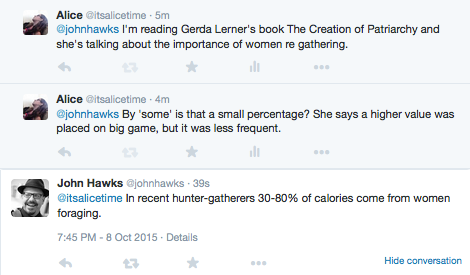
 Something I'd like to have verified is if hunter-gatherer societies, despite placing a higher VALUE on the results of big game hunting, in fact depended more on gathering and small game in their day-to-day existence. That sounds right, but we also hunted a whole lot of large species to extinction when we came to North America, so we had to have been killing them pretty often.

I tweeted at anthropologist John Hawks about this and his response was fairly vague (not his fault! the reality is vague!):


Sooooo "kinda." Kinda is the answer. Depends on where you lived.

Lerner seems to approach her subject pretty fairly -- when another academic stated that the position of goddesses in a culture meant they were a matriarchy, she says:

In view of the historical evidence for the coexistence of symbolic idolatry of women and the actual low status of women, such as the cult of the Virgin Mary in the Middle Ages, the cult of the lady of the plantation in antebellum America, or that of the Hollywood star in contemporary society, one hesitates to elevate such evidence to historical proof.


  The other chapters in the book are:

2. A Working Hypothesis
3. The Stand-in Wife and the Pawn
4. The Woman Slave
5. The Wife and the Concubine
6. Veiling the Woman
7. The Goddesses
8. The Patriarchs
9. The Covenant
10. Symbols
11. The Creation of Patriarchy

Gerda Lerner is most probably the shit.

Yes. Most probably indeed.

Thursday, October 8, 2015

Monkalong II: If you're a lady over 40 in this book, you're probably already dead

EVERYONE HAS A STORY. And Don Raymond certainly has one. Which he would like to tell you about. In excruciating detail.

DON LORENZO IS ROBERT DUNDER

So the section (which I'm sorry we had to read all of, but we had to get through it eventually) is Don Lorenzo's BFF Don Raymond's endless story about how he got around to banging Don Lorenzo's sister. THAT WAS FOR REAL THE REASON FOR IT. 


Basically, he almost got murdered by some banditti in the forest, then he saved a baroness while his servants were stabbed to death, then he fell in love with the baroness's niece, but the baroness was in love with Don Raymond (which is obvs pathetic because she's over 40 and M.G. Lewis is not on board with that age being a thing for women)

Main things we should note:

1. The wife of the banditti leader, Marguerite, makes "a sallad." So apparently that was a thing in the 18th century. And now I want to look up the history of salad.


AND WHY WOMEN LOVE THEM SO MUCH AMIRITE

2. Don Raymond is a dick for not telling Agnes his real name. Like, yeah, I get it when you're first meeting her, 'cause you want her to fall in love with you and not your heaps and heaps of Scrooge McDuck coins, but when you're about to elope with her, MAYBE say "Hey, so I totes didn't trust you before, but my name isn't Alphonso hahaha call me Raymond I know they're about equally bad as names so you shouldn't care."

3. Agnes is going around, drawing pictures of bleeding nuns and nobody thinks this is weird.


4. 
While I sat upon a broken ridge of the Hill, the stillness of the scene inspired me with melancholy ideas not altogether unpleasing.
 Romantics suck.

5.
An Author, whether good or bad, or between both, is an Animal whom everybody is privileged to attack; For though All are not able to write books, all conceive themselves able to judge them.
 Give it UP for Matthew Lewiiiiiiis. Tellin' it like it IS.

So, I'm psyched for the story to finally move forward, and it looks like the Monk is in the VERY NEXT CHAPTER, having just banged Rosaritilda. Exciting.