Thursday, August 29, 2013

If you want to call me raving about Jane Eyre and The Breakfast Club, I will listen

You know what sucks? We as a people don't get as excited about Things That Came Out a Long Time Ago as we do about Things That Have Just Come Out. Now I know that sounds obvious. But what I really MEAN are Things That Came Out a Long LONG Time Ago, so they're new to us. We should be AS excited about those things as the song 'Blurred Lines' (omg so catchy), but that is usually a no-go.

At least a part of that is because we don't want the 'Uh, obviously' reaction. "YOU GUYS I JUST LISTENED TO 'TRAGIC KINGDOM' AND IT'S THE GREATEST." "Yeah, we know that. We were all really excited in 1996. But now we're over it. We still like 'Spiderwebs' though. Man, what a great song."


They will not jump on your excitement train

There's the calm "Of course it's great" reaction of others, which is inevitably coupled with the Plight of the Lone Excited One. One of my favorite analogies for the importance of church is that a coal burning on its own soon burns out, but a pile of coal burns on. So if you're the only person excited about something (*cough*FrancesWillard*cough*) it can be difficult to maintain that enthusiasm, because no one else cares. Except the lady archivist at the FW Library. She will TOTALLY GET IT when you talk about Mary Bannister and the calamity of 1860.

So. What to do. My philosophy in life is to be jazzed about as much as possible, because there's SO MUCH AWESOME STUFF and it should be recognized as such. Sure, other people have known about it for a while, but that doesn't make your discovery of it any less fantastic. The Grand Canyon's been around for-fucking-EVER, but if you came from seeing it, people wouldn't say "Oh, yeah. Yeah, it's pretty great, I guess. Way to see it ten years after I did, though." LET US APPLY THIS TO MAN-MADE THINGS AS WELL.


Things I Have Discovered This Year and Will Discuss Excitedly With You If You Want:


Footloose
Gossip (the band)
Frances Willard
Diana Victrix
Lillian Faderman
Les Troyens
Xena: Warrior Princess
Warehouse 13
Pitch Perfect
Agatha Christie
American/British women's suffrage


AND OTHER THINGS I CANNOT REMEMBER. I want it to be culturally acceptable to rave about the song 'Mrs. Robinson' despite it having come out in 1968. And to tell everyone there is the BEST painting by Whistler at the Frick and let's all go stare at it and then maybe come up with an elaborate backstory and write some fanfic about it.


More excited appreciation of old things.
Monday, August 26, 2013

I will sing The Piccolino unsolicited at our next gathering

You know, sophomore year of high school, my biology teacher asked us what we did during spring break, and I — completely voluntarily — proclaimed that I spent the entire break watching every Fred Astaire and Ginger Rogers movie MULTIPLE times and now knew all the songs.


It is either a sign of how uncool my school was or how well my classmates knew me that I 1) didn't get my ass kicked, 2) didn't have any shit said to me about this.


Along with my theory of balance, I'm a firm believer in owning up to your dorkier interests. It plays into the theory of balance, because if we all know at least one embarrassing thing about the other person, no one can peer down on someone else from their obnoxiously high horse.


If someone handed me the Fear Street Saga books right now, I would read them. And then I would discuss them with people who had no idea what they were, because apparently I am the ONLY ONE who read the books about Simon Fear and his wife Angelica, which are the greatest because they involve frilly shirt cuffs.


History makes everything better

I'm trying to think of other things I could potentially be embarrassed about, but part of the wonderful thing about the theory of balance is that I'm also reading the journals of Frances Willard and a book about the 1886 Haymarket Square riot, so if anyone gives me shit about other things I'm reading, I can just hit 'em with those. They're pretty heavy.


Now some of you are saying, "But Alice, if the theory of balance means you don't judge people, why do you judge people alllllll the time?" Well, first, I can be an asshole. And second, the theory of balance means you can read bad AND good things. If you only read bad things, then Judgment City: population me (you will be sitting outside the gates somewhere. being judged).


BY THE WAY, if you want to see Fred and Ginger kiss, you are best off with The Barkleys of Broadway. Carefree is hilarious, Flying Down to Rio isn't worth it, and the Britney Spears song 'Where Are You Now' played at the end of The Story of Vernon and Irene Castle will make 15-year-old girls cry.


Friday, August 23, 2013

Outlaw Marriages: A book I haven't finished yet

You might have noticed that I've been reading rather more nonfiction than usual lately. It seems like most of us tend to skirt that genre, and I'm not sure why (except for the fact that narrative is the FUNNEST). I'm really into history, and I'm really into poking around in it for gayness, so lately I've been doing both of those and acting like a kid in one of those germ-filled ball pits from our collective childhood: *holds up a ball* "Oh! Jane Addams, what're YOU doing in here!"

I've started a book called Outlaw Marriages, which I assuuuumed was just jumping on the gay marriage bandwagon, and maybe it is, but whatevs. So I wasn't going to take it too seriously, because it says stuff like:

A third line that scholars cite is one that tells of a young man in camp being valued “more than all the gifts of the world”—the phrasing speaks to Whitman’s love for Doyle being more important to him than worldly goods.
Does it? I would've had a hard time connecting those things. Thank you. I also enjoy "scholars cite," but then it's followed by dumbness. 

When I started it it also seemed pretty much like "Let's put a relationship construct of the 20th century onto previous generations!" which...y'know.


But then I kept reading, because it's broken up into stories (one chapter per couple), and it's not even necessarily just the COUPLE, but it also talks about what they did. And -- THIS IS THE REASON I LOVE HISTORY -- when you've read enough history, all the different parts of what you've read start interlocking like jigsaw pieces and it is the MOST fun.

Like they mention Elsie de Wolfe and Bessy Marbury, and at first I was like "Oh, ok, these people" and then I googled them and a book about the TRIANGLE FACTORY FIRE came up, and it was all "They helped with the shirtwaist strike of 1909," and THEN the book revealed that so did Alva Belmont, who worked closely with -- wait for it -- Alice Paul in the battle for suffrage. 

IT'S LIKE THE KEVIN BACON GAME BUT WITH HISTORY.


People wanting to put contemporary values/perceptions on anything in the past make me more irritated than when someone cuts me off while walking AND THEN SLOWS DOWN. Which is quite a lot, as I mentally turn into a furious adult baby when that happens. So the concept of same sex relationships of the past being marriages makes me a little *looks suspiciously at the author* because almost no one was able to break free enough of the culture to see that as a possibility. 

However. When M. Carey Thomas, president of Bryn Mawr from 1894-1922, wrote to her mother that "If it were only possible for women to elect women as well as men for a 'life's love,' I would do so with Mamie in a minute," and that she wished that "Mamie and I could go through the marriage ceremony together," I mean....

y'know?

I'm ALSO learning about gay dudes, which is a topic I have heretofore ignored, possibly because I'm bitter about the proliferation of gay male bars in Chicago while one of the two lesbian bars just closed (and by possibly I mean yuuuuuuup). BUT! But, I now know about J.C. Leyendecker, and how his art was amazeballs AND he was basically married to the Arrow Man (Charles Beach). Have you seen his painting of the Arrow Man?


Why, hello

So while the intro was not great and some of the claims should probably be extra-researched, he DOES have nice notations and cites a lot of primary source material. And he's making me think that same-sex marriage as we understand it now, is not, in fact a 20th century construct. Well done, sir. Looking forward to that chapter on Rauschenberg.

Wednesday, August 21, 2013

Inferno: Will this Dan Brown novel have some twists? Oh, I hope so.

Making fun of the writing in a Dan Brown book is kind of like shooting enormous fish in an unusually tiny barrel.


Or like shooting a stealthy Dan Brown

So I won't comment on how the heroine is "strangely attracted" to the hero who "in addition to his being handsome...seemed to possess a sincerely good heart." You know who people are strangely attracted to? Ozzy Osbourne in his current state. Or Paula Deen. THOSE are attractions where you look at yourself or the person saying it and go "....huh." If someone is handsome and nice, it's 'unstrangely attracted to.' Or just "attracted to." You don't need a qualifier. We get it.

I also won't comment on how the heroine is a beautiful genius who at one point says "He would never want me. I'm damaged." A DAMAGED BEAUTIFUL GENIUS WOMAN TELL ME MORE DAN BROWN.

Okay, so getting past those points, Inferno is completely normal Dan Brown. Robert Langdon awakes! Where is he! And then boom! PLUNGED into a perilous situation. This one has to do with Dante and Florence, then Venice, then other places THAT I WON'T GIVE AWAY BECAUSE OF PLOT REASONS. And the end of the world's being threatened, so using his art history degree or whatever, he and Beautiful Damaged Genius run around the cities of Europe, racing against Evil Antagonist's plot, but FORTUNATELY they're also not in too much of a rush to give us some art and architecture info on the way (albeit hurriedly).


Like that, but with Florentine art

Which is weird because Dan Brown books are all like "Secret society! What's going on! Only this handsome older symbologist who isn't Dan Brown at all can figure it out! Damaged younger female who's attracted to handsome symbologist but never in a sexually aggressive way! That one fanatical stalker character who's always there!--And now we turn into a travelogue for a while and yes, you can google pictures of the things we talk about and aren't you GLAD you know about the history of the Duomo now?--PLOT TWIST PLOT TWIST PLOT TWIST Robert Langdon sipping Scotch The End."

I don't really get the travelogue part, but I enjoy google imaging stuff and I do like travelogues, so it all works out in the end. Except when he gets too much like a non sequitur Wikipedia article:

the breed’s modern name, Friesian, was a tribute to their homeland of Friesland, the Dutch province that was the birthplace of the brilliant graphic artist M. C. Escher.

I was furiously anti-Dan Brown in college. The Da Vinci Code had just come out, and Facebook was in its infancy, so Favorite Books still had a prime place on your profile, and every sorority girl on campus had The Da Vinci Code and Angels & Demons listed. And that was it. Some would maybe be adventurous and add something like The Devil Wears Prada, but those two were ubiquitous and it enraged me, because I was 19. And an asssshole about it. To the point where I had a "Reading" and a "Not Reading" list posted on my profile, and the only things the latter contained were The Da Vinci Code and Angels & Demons

Then the books waned in popularity. I got older and cared less. And I read The Da Vinci Code and it was fine. I was entertained. Which is the PURPOSE OF DAN BROWN BOOKS. No one expects them to be works of art. The prose sucks and should really not even be called prose. Just "words." The words Dan Brown chooses suck. But that's why you skim and then you get taken on a rollicking adventure through Europe and are maybe given some questionable "facts," -- so make sure you google that shit -- and then there are tons of twists and it's all very exciting. Dan Brown: it'll relax your brain.


So many twists.

Sunday, August 18, 2013

Passions Between Women: British Lesbian Culture, 1668-1801

Emma Donoghue, author of Room and various other novels and short story collections, is also a fancy scholar lady with a PhD from Cambridge. Back when I got all into Helena/Rosa from The Mystery of Edwin Drood, I became very frustrated with the fact I had no idea if the language surrounding their interactions was normal for the period or was imbued with some subtle code, so I checked out a mess of books from the library about romantic friendship and the history of lesbianism in England. That was in January. Being me, I have just finished the second of those (the first, if you will remember, was the fabulous but unfortunately-named Surpassing the Love of Men).

Donoghue's survey, which is more historically-based than literary, looks at the years 1668-1801 in Britain. She covers "female hermaphrodites" (as lesbians were thought of for some time); women who crossdressed and then married women; romantic friendship; and lesbian communities, which might not have existed in the same way gay male clubs did, but were nonetheless a genuine part of society.  


She disagrees with Lillian Faderman's conclusion that "even slight suspicions...concerning female same-sex affection are quite rare" in 18th century texts. Part of the reason for this disagreement is that in the ten year gap between Faderman and Donoghue's books, many new documents came to light which show the snarky 18th century having a general field day with insulting poems using barely disguised names of Ladies of the Day and discussing their "unnatural" relations with each other (relations which were, of course, sometimes fabricated by the author in an attempt to defame the women).

thank you, Mindy.

What I found fascinating near the end of the book was the 18th century shift in translational practice for Sappho's poetry. Most everyone knows about how the Restoration court of the 17th century was famous for being a BIT risqué, right? And that Restoration comedies are the filthiest? And that one of the most famous dramatists from that period, Lord Rochester, basically died from a million STDs + booze? 


Right, so we come off that into the 18th century, and at first, people are like "Hey, here's a poem where Sappho's jealous of a guy for sittin' by her lady." Then as the century progressed, it changed to "It's QUITE obvious that she is, in fact, jealous of the lady for sitting by her gentleman friend. I know the first two lines completely belie that but I WILL THINK WHAT I WANT TO THINK." Someone changed the line "Bless'd as the immortal gods is he,/The youth who fondly sits by thee" to "Bless'd as the immortal Gods is she,/The maid who fondly sits by thee." So that happened.


I remember as a freshman in college being taught Sappho and being SO UPSET that it was impossible to interpret her poems as being anything but...well, sapphic. I remember having the same level of frustration as these 18th century men, but took solace along with them in the (disputed) fact that she ended up killing herself over a man. When you want to claim everyone for heterosexuality, you became easily exasperated by anyone saying ANYONE is otherwise, and instead of admitting "Yes, there are people like this in the world and always will be," you get to fall back on the delightful "Well, they just want to say everyone's that way, so they'll twist facts about people who are THE STRAIGHTEST when you just see them in their proper historical context."


Sometimes things are gay. And that's all right. Some ladies in the 18th century loved each other and didn't want to be with men. And it was hard for them to do, but some, like the Ladies of Llangollen, did it.


Tumblr has all the answers

I'll conclude with a hilaaarious anecdote, which pretty perfectly expresses the difference in interpretation even ten years of new research can make. A brilliant woman named Hester Thrale kept a diary in the late 18th century, and while she was deeply suspicious of all her friends who were in a "romantic friendship" situation, she praised the Ladies of Llangollen, which scholars saw as rather paradoxical, as these women's romantic friendship was the flagship for the movement. Faderman and Randolph Trumbach use Thrale's different attitude towards them as proof that said ladies were seen as chaste friends by the public.

Recently, however, Liz Stanley has unearthed an unpublished diary in which Hester Thrale describes the Ladies of Llangollen as "damned Sapphists."


Friday, August 16, 2013

Love means never having to say you're sorry, except that's buuuuullshit

All right, this post will be entirely full of spoilers, so if you've somehow made it 43 years without knowing the plot of Love Story and were REALLY looking forward to reading or watching it, I guess skip this post.


That is my awesome copy that cost me $1.25. I'd like to point out -- number 1 bestseller and on the bestseller list for NINE. MONTHS. That book is tiny. Less than 150 pages tiny. Why do our bestselling novels nowadays have to be GINORMOUS? It makes no sense. Our attention spans are less than they were in previous decades, yet we're expected to read some person's 700 page tome called The Sad Truth About Violets

And I know Love Story is from 1970 and surrounded by 1970s hippie nonsense, but here's the thing: I really, really liked it.

So basically, it's all narrated by the male lead, Oliver, who's a senior at Harvard and comes from gobs of money and plays hockey very well and has ISSUES WITH HIS FATHER, which normally would make me put the book down right away, as strained father/son relationships are the most overdone thing on the planet. Author, this is fascinating to you and only you. Maybe see a therapist.

I'm just sayin' it's been done

BUT, in this book, I was totally fine with it. Partially because I genuinely liked the narrator a lot. There are so many potholes you can fall into in novels from the 1960s and '70s -- ex: something like Philip Roth where you've been psychoanalyzed to death and you're overly self-aware and constantly thinking about what your actions could mean about your subconscious desires and so all your writing is trying to get ahead of the reader and say "Yes I already know this about myself and ha-hah, look how I act towards my mother, maybe I'm into her -- didn't think I'd be THAT OKAY with myself, did you?"

This narrator doesn't do that. He just tells you the story of him and the girl he falls in love with. And it's charming. And normal. And great. And I got a bit weepy.

They meet (at a library) and she's refreshingly blunt and he's flummoxed by this and she comes to his hockey games and gets happy when he punches people (which, to be honest, is another kind of refreshing) and they get engaged in a delightful way and get married and she puts him through law school and then he graduates and gets a nice job and is SO EXCITED because he can buy her things and they were so poor before, and then they try to have a baby and can't and they go to the doctor and the doctor says -- Jenny's sick.

Jenny has leukemia and she dies. It's such a short book. My main reasoning on why it had to have been so popular is their relationship is real. It's so real and relatable and there's nothing really that dramatic or out of the ordinary, but you love them because they genuinely love each other.

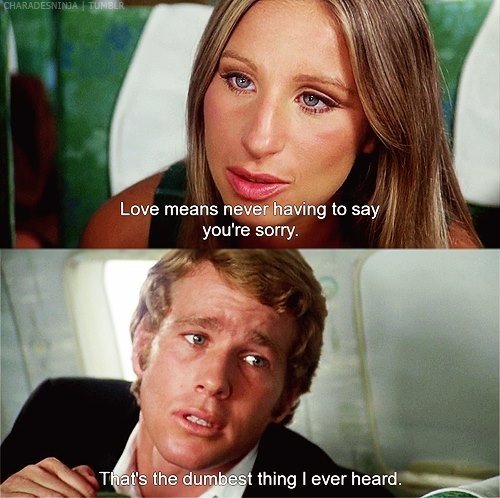
My two issues with the book (which you can read in less than an hour, by the way) are 1) The most famous part, which was made fun of in the film What's Up, Doc (starring one of the leads of the film version of Love Story):


Love means never having to say you're sorry? EHHH. WRONG. I say sorry to my friends ALL. THE. TIME. They know I love them, but if you act like an asshole to someone, you respect the damn relationship by apologizing to them. (I'd say 'or don't act like an asshole in the first place,' but everyone's got their days, amirite) I cannot even imagine life without the concept of apology. It sounds awful.

So there's that. Then there's something that's way more indicative of the time, but because I was born in the '80s still prompted a big 'WTF': Jenny's sick. The doctor calls OLIVER and tells him to come to his office. Where the doctor tells OLIVER that Jenny is sick, and they both agree NOT TO TELL JENNY. "We're gonna let you worry on your own in a delightful state of mysterious agony over what's wrong with you and why you feel terrible all the time." 


And the doctor is totally good with keeping this from her. She has MONTHS OR WEEKS TO LIVE and she does not know. Because Oliver and the doctor decide it's better for her. OMG.

So aside from that. Great, great, awesome book. And that's probably an embarrassing opinion, but

Wednesday, August 14, 2013

Frances Willard Is Really Great and I Read a Hundred-Year-Old Book About Her

You might've noticed I've been talking about Frances Willard lately (this is truer for the people in my real life, so let the feelings of sadness for them commence). While on this Willard Quest for knowledge, I came upon a 1913 biography of her written by British suffragette (and sister-in-law of Lytton Strachey) Ray Strachey called Frances Willard: Her Life and Work.

Being part of the younger generation, she did not know Willard personally, as she had died in 1898 when Ray was eleven, but she writes an excellent biography -- an adjective I doubted at the beginning when I read "in studying her life I have come almost to believe that she was perfect." I mean. That's not really going to make for an objective point of view. But I came off the book feeling like she's one of the better biographers I've ever read.


THIS IS ABOUT TO
GET WAY MORE
INTERESTING, DAMNIT

She does this by reading SO much about Willard and talking to SO many people who knew her (people she had ready access to since Willard was a big player in the suffrage movement of the 1880s and '90s and spent a decent amount of time in England) that she develops a sense for the actual person, enabling her to critique FW's autobiography and writing: "It seldom gives any true picture of Frances Willard to quote what she has written."


So it's a good book.


Now as to Willard herself. She was the president of the Women's Christian Temperance Union (WCTU), was a BADASS LEADER, looked for the good in everyone, said awesome things like "I will not waste my life in friction when it could be turned into momentum," stood up for suffrage when it was THE UNPOPULAREST -- even among the women in her organization --, was responsible for the installation of public drinking fountains, and wanted temperance because CAN WE GO OVER IT AGAIN DRINKING WAS A HUGE PROBLEM ESPECIALLY FOR THE HUSBANDS OF IMPOVERISHED WOMEN.


it was less of this and more of like, wife-beating

This wasn't some prudish Christian woman blinded to the realities of life who was trying to ruin fun for everyone FOREVER. She was basically a way more interesting version of Laura Ingalls Wilder, living in a cabin in the woods of Wisconsin when Wisconsin was called "the West." She kept a journal in her adolescent years that's my favorite part of her life. She called spring cleaning "the scourge of mankind" and when her father told her she couldn't ride a horse even though her older brother was allowed to, she trained a cow to wear a saddle. When her father saw this, he finally said okay, and about this her journal says:
Hurrah! rejoice! A new era has this moment been ushered in. Rode a horse through the corn. Oh! it is nice -- the acme of my hopes realized.
She was so amazed by the good temper of a neighborhood girl that she stepped on the girl's toe at recess to see if she would frown (she did not). She finally got to go to school in her late teens and wrote delightful things like "To come down to frying onions, when I've been away among the rings of Saturn, is a little too much!"

I am the small alien monster
in this situation

She was in a place in Wisconsin that DID NOT EVEN HAVE A ONE ROOM SCHOOLHOUSE until they built it in her teens. When they built it and she got to start going to school, she said "I am very terribly glad, exceedingly, excruciatingly glad." Because you couldn't take education as a given in 19th century rural Wisconsin.

Someone gave her a pistol that she decided to name Defiance. "It is a fine one. Everything between a quail and buffalo beware."

One of my favorite stories about her, because she tried SO HARD to be good and to obey God and not let her temper run away with her, but then when she was about 17, she read a novel for the first time. And said novel was by Charlotte Bronte (the bio didn't specify which one). She was at her cousins' and they had all three. She was on Villette when her father came to get her. She was sitting on the doorstep, totally into it, and he walked up and forbade her from reading more of it, as he was anti-fiction -- "which command she obeyed, although with an anger she did not dare to express."


So then it's her 18th birthday. She's at home with her parents. She gets up, sits in her mother's rocking chair, and pulls out Ivanhoe. Her dad comes up and says "I thought I told you not to read novels, Frances." And she says "So you did, father; but you forget what day it is." "I should like to know if the day has anything to do with the deed!" "Indeed it has. I am eighteen -- I am of age -- I am now to do what I think right." And so she got to read novels.

And then -- AND THEN. She was at college and reeeally thinking about her faith and whether she believed Christianity was right, and she said SUCH AWESOME STUFF OMG remember this was the 1850s:
If I truly believed that the fifth chapter of Ephesians (22-24) was to be understood literally, and applied to me if I am any man's wife, I should think the evidence sufficient that God was unjust, unreasonable, a tyrant,  But, as it is, I do not. This is my way of thinking, and I have a right to it. That right I will maintain.
Aghhhhhh. So great. 


(like Paul)

Everyone loved her And she was awesome in social situations. She went to a college party once and said "We all seem to be in good health, the company is pleasant, and the evening a fine one. These subjects being duly disposed of, what shall we talk about?"

Awesome. BUT she was also, obviously, a product of her time. So we get things like "I wish I were a better woman. Burke says that the traits most admired in women are dependence, softness, timidity, and I am quite deficient in them all," and "What a hunter I should have been if God had thought it best that I should be a man!"


She could have led the Barden Bellas to honor and glory

One of the things that kills me most about her younger days (her cow-taming days) is she used to be able to run around and climb trees and shoot things and finally she reached an age where they said her hair had to be put up and she had to wear long skirts and this happened and it makes me want to punch The Past in the face:
To her friends she often described how, when the deed was done, the hairpins in place, and the skirt really lengthened, she ran off, blinded with tears of rage, falling over her skirt as she ran, with her eighteen hairpins standing on end and pushing against her aching head, and made her way miserably to the cellar, where she lay for hours sobbing and crying and feeling as if all the joy of life were over for ever.
HOW DO YOU NOT LOVE THIS WOMAN? Okay. So let's take all the previous stuff, and then say that this woman, who saw potential in everyone and had faith in them thereby making them have faith in themselves, that she saw how alcohol was ruining the lives of men, women and children. Particularly of the poorer classes. That she saw no way that it was helping society. That those people might have a chance of actual happiness in this world if alcohol weren't there as a disastrous substitute. SO YEAH SHE FOUGHT HARD TO GET RID OF IT.


And she ran a worldwide organization, traveled internationally, and spoke so eloquently and forcefully that she at one point made an older member of the Temperance movement dissolve into tears after she was done. When someone asked what was wrong, the woman sobbed "Frances Willard has just convinced me that I ought to want to vote, and I don't want to!"

She went south of the Mason-Dixon line in the 1880s, when people from the North didn't go there and weren't trusted -- especially pro-suffrage women from the North, when suffrage had been invariably linked before the War with abolitionism. When she died, flags were at half-mast "from the Atlantic to the Pacific." She was the best-known woman in America, but as Strachey says in 1913, "Frances Willard is one of those whose influence is felt long after they themselves are forgotten.

To end this longass post (I AM SORRY), here is Frances Willard not long before she died:
"I do not know that the strong hand of labor will ever grasp the helm of state, but I believe it will; I do not know that the double standard of life for men and women will be changed, but I believe it will; I do not know that women will bless and brighten every place they enter, and that they will enter every place, but I believe they will."

Monday, August 12, 2013

Millennials and the Enlightenment: We are the new 18th century assholes

I've realized something, and that is that I am terrified of the 18th century the way I'm terrified of a group of teenage girls walking towards me on the sidewalk.

If I had to pick any century to live in, the 18th would be wayyyy down the list. They're so funny but they're SO MEAN. If you read anything about the 18th century's literary trends, you'll keep seeing things like "Oh, the Countess of Marlborough was the best of friends with Lady Athelton, but here's a mock epic she wrote about how Lady Athelton's feet smell and also she's a whore."


WHY 18TH CENTURY WHY WERE YOU SO MEAN


It ALMOST makes you understand Romanticism. Like the Enlightenment's kids were so sick of nothing being sincere and everyone just being assholes to each other (hilarious assholes) that they were like "I LOVE YOU BEYOND THE OCEAN'S DEPTHS LET'S TALK ABOUT DAFFODILS AND ALSO OUR FEELINGS."


And their parents were just standing by like


Their whole game is to one-up each other with hilarious put-downs, and this game has no end and seriously the only thing that stopped it was them dying. I'll bet Pope was on his deathbed being like "I may perchance be dying, but at the very least my mother didn't dress like a Turkish prostitute like Lady Churchill's, amirite."

And part of what terrifies me about the 18th century is that there are wayy too many parallels to the Millennial generation. What do we value most? Humor.

our excuse for everything

Sincerity is SCARY because then people can make fun of you for it. What worries me about this whole situation is we have cultural doxa, right? Where everyone just knows this is how it is. This is truth and everyone accepts it. EXCEPT IT ISN'T TRUTH IT'S JUST THE STANDARDS OF THE TIME. Which is how everything got flipped on its head from the Enlightenment to the Romantic period in terms of values and whatnot. 

So if we're currently in a cynical, hilarious time that's pretty damn concerned with science being the ultimate thing (and we are), then that means we're due for a switchback and all those babies being born now are going to end up being like Wordsworth and writing about the beauty of a tulip. Or the man/technology connection and how the two are melding and oh isn't it glorious and let's talk about how we feel about that. WHATEVER SOMETHING GENUINE AND NOT FUNNY. And I guess in some ways it'll be a relief? Because I do feel constrained sometimes by fear of being mocked for actual feelings, but at the same time, I 100% value humor over pretty much everything.

But it's not like the people of the Enlightenment stopped being hilarious when the Romantics came into being. They were just old and didn't adapt to the new poetry styles. So we'll still be posting awesome things on Facebook. We'll just also be the only people left on Facebook.

Wednesday, August 7, 2013

The Brontes are basically my default mental topic, but y'know, whatever, man

Despite all the instincts of the better part of my soul, here I sit typing and attempting to form coherent sentences. So goes the human condition! Soldiering on in the face of any adverse circumstances. Not that I'd be doing this if I had the option of napping. Then I'd say "Fuck adverse circumstances" and go to sleep. But as I do NOT, here I am, a triumph of millions of years of evolution, with a brain and the current semi-ability to walk upright and all that comes with those startling attributes.


I spend a lot of time thinking about the Bronte sisters. Mostly because they're really easy to make fun of. THEY JUST FEEL SO MUCH. Oh. Except Anne. I mean, she feels stuff. But I'd never make fun of her. Because it always feels like she's kicked around by the other two, even though she was NOT, it just feels that way because that's what the literary public's done.

Public, may you be cast into the pit of Endless Remorse and Thinking-It-Over-Again, for while Tenant of Wildfell Hall is not the greatest piece of literature in the Western world, neither is fucking Shirley. AND Agnes Grey actually shows how horrible being a governess was. Which was a HUGE PART of the Brontes' lives, but their books address it zero. Zeeeeeero. Anne had to do it. And it's a charming, awesome book that made me viscerally angry when one character acted like a bitch, and it's always the snail's petticoats when that happens.


I've said before that a big problem with the Millennial generation is we are rarely sincere because sincerity opens one up for being made fun of. And I'm not helping my case with talking about the Brontes, but they were such a weirdass meld of Romantic and Victorian, where it's like "STRICT MORALITY -- but oh hey there, whipping winds and fiery storms and illicit love -- BUT WAIT LET ME TIGHTEN MY STAYS A BIT MORE BECAUSE GOD DOESN'T WANT US TO BREATHE."


Also they're three women (after their other sisters died), living pretty much alone in this house in Northern England, next door to a cemetery (noooot thinking about their drinking water) and egging each other on with the guys they find attractive, who are all like their brother and it's weird but hey, isolated family in the 1800s. Okay.


I hate Romanticism. I can tolerate/love the Brontes despite it because they're less self-indulgent than the poets. "Behold how much I adore this tree/Oh! the palpable specialness of me." Boooooooo. You be self-aware, damnit, and you be it now.


The Brontes should be the irritating next door neighbors who sometimes walk with me to the 7-11 for snowcones. And then Emily starts to talk about the endless vista provided by the plains of Illinois and I'll say 'EAT YOUR DAMN SNOWCONE, EMILY.' 

That's all I want.

Monday, August 5, 2013

Temperance, and I Enjoy Frances Willard's House Almost As Much As She Did

I cannot overestimate the level of indifference with which people will respond when you tell them you have JUST come from a tour of former president of the Women's Christian Temperance Union, Frances Willard's house.


I'd never heard of her either. Which is a SHAME because she is one of just six female statues in D.C.'s Statuary Hall, and was the ONLY one from 1905-1980. I was watching the Ken Burns documentary on Prohibition while cleaning the other week, and they started talking about Frances Willard and how she effected actual change with the WCTU (and linked it up with the suffrage movement, making it more socially acceptable for women to opine for suffrage), which before her was pretty much just going in front of taverns and praying, which is ALL WELL AND GOOD, but when you leave, the guys are just gonna go back in and keep drinking.


She went to every town that had over 10,000 inhabitants in the United States and lectured and recruited members and then eventually we had Prohibition, WHICH GRANTED DID NOT GO SO WELL, but I think when people think about Prohibition now and make fun of it, they think of it in the context of our current drinking culture.


Our current drinking culture is, overall, tame. We don't need to outlaw alcohol. In the early 1800s, everyone was growing grain,which could be distilled into whisky. So instead of beer, which people had been drinking for ages with every meal, they were drinking whisky. And they didn't quite realize that you couldn't drink the same amount. You also had soldiers coming back from the Civil War who'd been dosed up with hard liquor because it was a cheap anaesthetic, and now they were alcoholics who spent their paychecks at the bar and left their wives and children without money or food.


What I'm saying is, make fun of the Temperance movement, but it was NECESSARY.


do we really want this? (yes)

And the awesome thing about Frances Willard's house is she was so famous in her time, that right after she died, people were like "Preserve this shit," so instead of visiting and having the tour guide be like "Well, this is how it MIGHT have looked back in the day," they're like "HERE IS A PHOTO OF HER LIVING ROOM AND HERE'S ALL THE EXACT SAME STUFF IN IT."

She also had a little sign to hang on the outside of her office that said "This Is My Busy Day" so people wouldn't disturb her. And they have the sign. And her books. You guys. Her books. She has so many. On suffrage and botany and the voting population of New Hampshire and temperance (natch) and AN OLD-ASS COPY OF VILLETTE and something called The Intellectual Life and there was no damn internet so she chose to just cover her walls with shelves of books.

And they were all caj-like saying "We know they're hers because there're annotations in pretty much all of them."

Good Lord.

SO. If you're in Evanston (north of Chicago, but accessible by the El train) on the first or third Sunday of the month and available between 1 and 4, you can visit! And go on an hour-long tour and derail the tour guide with way, way too many questions, because it's important to know whether that chess set is the chess set SHE played with, damnit (and yes it is).

Friday, August 2, 2013

You Should Be Reading Michelle Tea

A while back, someone asked me to make a list of LGBT lit. "I...pretty much only read the "L" part of that," I answered. So it was amended to a list of lesbian lit. Regardless of whether or not you're gay, it's important to read its literature, the same way it's important to read other nations' or races' literatures. "Omg! Debatable comparison!" you say.

NAY. Because what they all have in common is a different experience and point of view. If a person is anything other than what YOU are, they have a different point of view. Your family has a different point of view than you, so imagine how a person who is STILL being called an abomination (but now only by select idiots) must see the world.

don't tell me that doesn't mean something

When making this list, I did research, because I haven't actually read most of the canon lesbian lit. And I kept seeing Valencia by Michelle Tea. So the next time I went to the library, I picked it up off the shelf. It starts with a girl drinking at a bar, trying to impress a girl she wants to have sex with. It struck me as seedy and potentially trashy and totally not my world, and I almost put it back, but I found that I really, really loved the writing, so I ended up checking it out. And completely loving it.

After Valencia, I decided to read all of Michelle Tea's books, so here's Rose of No Man's Land. It concerns a 14-year-old girl with a poor, mostly uncaring family, and almost all of the book takes place in one day -- like Star Wars. But UNlike Star Wars, it deals with what I'm going to term a stream of consciousness set of events, where instead of anything making sense, the main character (Trisha) and her new friend Rose (like the title!) wander from place to place and it's poetic and awesome and I really do love Tea's writing.

We looked up at the wide bowl of night, squinting for stars, but you can't see any above Route 1. We'd traded stars for the tall neon sculptures that advertise the restaurants. I say who cares. It's not like we can make the stars extinct. The stars are the last bit of nature we can't fuck up; we only fuck it up for ourselves, stacking lights on top of lights 'til we blot out the sky.

Even smaller scenes, like when Trisha's eating at a place called Clown in the Box:
I picked at the vegetable nuggets. I lifted a blobular crusty one from the paper boat and blew and blew until the oil shining on the stiff batter didn't look scalding. I popped it into my mouth and sucked in air to cool it off. 
Her writing's evocative and holds your attention and she needs to be read more. She's one of the few authors whose style itself -- as opposed to a particular plot choice -- makes me want to read all her books. I don't really care what the topic is -- I know I'm going to like it regardless. I guess Rose of No Man's Land could be classified as YA because it deals with a 14-year-old, but it doesn't feel like YA.  It's just really good. She has an actual YA book out now about mermaids. MERMAIDS ARE SO HOT RIGHT NOW.

So. Yes. Michelle Tea. WHEN HAVE I STEERED YOU WRONG WITH AN AUTHOR THAT WOULD BE NEVER.